0:00
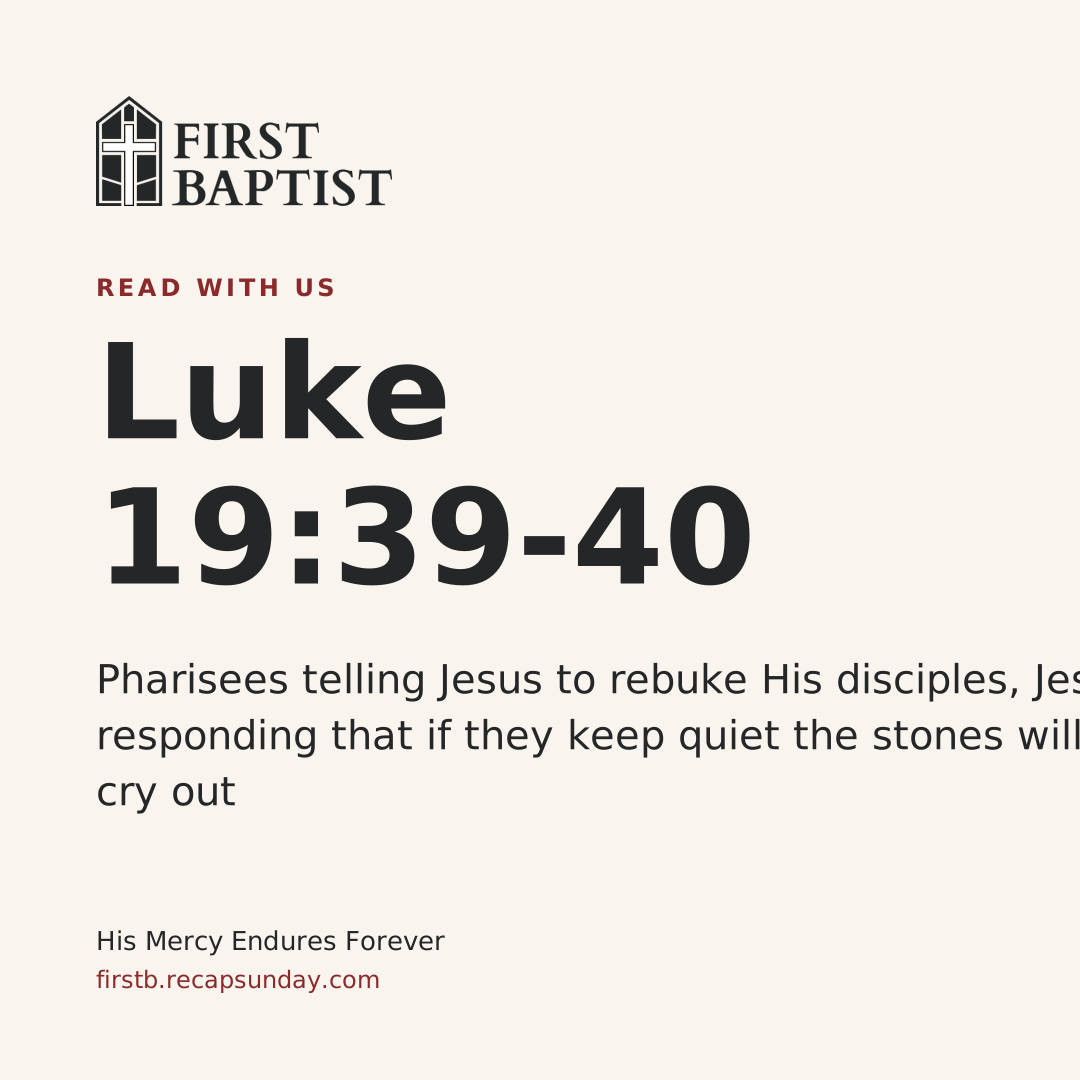
Speaker 2When Jesus is riding in Jerusalem on the donkey and some of the pharisees in the crowd were saying to Jesus, teacher, rebuke your disciples. And Jesus said, I tell you, he replied, if they keep quiet, the stones will cry out. We are giving praise to our savior. Let's not forget who we are singing to. This is the God who created us, the God who loves us, the God who deserves glory and honor.
0:24
Shall we praise him?
0:25
Speaker 1The weekly announcements. I'm gonna go through the ones we always do, but also highlight some special stuff that's special for this week, Holy Week. Rinsey, are you doing that? Am I doing that? Here we go.
0:39
This one is unusual. This is a bit of an unusual announcement but y'all know Marilyn Larson and Grant Larson. They go to church here. They're usually in the second service. Marilyn Larson has a quilt and some of y'all are quilters.
0:51
Her daughter called and said there's a super duper wonderful quilt. It's on display at the hospital. It's called Crown of Thorns. It has an Easter theme to it. And if you end the quilting, that's where it is.
1:02
At the PCU unit in the hospital. So Marilyn Larson's quilt, Crown of Thorns. I hear that it's worth seeing. I meant to get by there and didn't this week. So that's the connect hour between services that starts right after this service and goes till the next one gets going.
1:19
Middle schoolers, ho drum, just like always. No. Really, they'll be fun tonight. 06:30 this evening, Solid Rock Youth. That's for middle schoolers.
1:29
Awana's, every Monday pretty much. Well, most Mondays. Starting at six, we didn't do it over spring break but we're back in force. Guess how many game ends this week? There is a tub of clothespins in there on Diane's office and there's a tub of army men in there and the guess how many game ends this week and their prizes included in that.
1:50
Monday nights at first B, multicolored this week. We're doing meal, music, and a message every Monday night. Carl is going to preach tomorrow from Matthew. Choir practice for the final three practices for the Easter encounter. We have one today after the second service.
2:09
We have one on Tuesday evening and we have one next Saturday morning, the nineteenth at 10AM right here, right there in the choir loft. And might as well mention right now, would y'all consider just spending the morning with us next week because this cantata is awesome. It's powerful. I'll get back to that in a minute. Men's fraternity, Wednesdays.
2:29
Dan, is that on this week? It is on this week. After that, we have prayer meeting in the office in there. This is the ladies seder. It's an introduction to the Passover, introduction to Passover Lamb.
2:43
Christine Schuler and lots of other ladies but Christine has been our emcee. She's a messianic Jew and she is explaining the rights and the reasons, and it's been great. So 07:30, like I said, Wednesday. That one this week is gonna be from 11:00 until one. That's what I thought.
3:04
For the Seder. It's lunch time and it will be, there will be lunch there. 07:30 on Wednesday mornings, every Wednesday morning, we have prayer in my office. The Bible study, we're going to skip through that for right now. This is a picture from the movie, The Passion of the Christ.
3:21
We went through the legal rumblings to be able to show movies and we don't do that very often and so this Thursday, we're working towards showing the passion of Christ. I didn't put any time up. What did you say? Seven? Renzy says seven.
3:36
So, alright. We're going to show the passion of Christ here in this room at seven and it is not something that's a very light story for kids and or for adults. As a matter of fact, it's pretty tough but Maundy Thursday, we do not have a scheduled service plan. So, we decided that we would show that. Friday morning, breakfast frenzy with Renzy at 07:30 at Callways.
4:01
Now, this is an outline of Easter morning. How it's going to go? Easter morning, 9AM service will be participatory worship in song with the band and also several guests and I will give you a brief Easter message. He smiles when he says that. A brief Easter message and then at the eleven, our choir will present a very powerful Easter cantata featuring various solos from among both services.
4:24
So there are like seven soloists, I think. One of them is a trio, but they're just from among you. They've chosen from among you. It's gonna be awesome. And then I will give a different brief Easter message.
4:36
It will be not exactly part two, but there'll be two different messages. That is the way Easter's gonna look. And the connect hour. Nothing says he is risen indeed like a big stack of sourdough pancakes. Breakfast will be served from 09:30 ish to about eleven or 11:30 ish.
4:59
We'd like to be back in here and quiet and comfortable. Whoo. Comfortable, but not having to sing. Y'all could just sit back and relax and people will sing to you. So, pancakes, sausage, bacon, probably eggs.
5:13
It it will be good. So, plan on doing that. Just plan on spending the morning next next Sunday morning, Easter morning. So, there it is. 09:00, sing up an appetite.
5:22
In between, eat a great breakfast and then eleven, sit back and enjoy harmonious godward praise and welcome to First B. You want to greet one another, Carl?
5:33
Speaker 2Yeah. We should. And while we're greeting one another, we've got some young worshipers with palm branches ready to praise as well. So we'll invite them forward. And then, would you guys stand up, greet one another, and we'll, we're continue to worship in song.
5:47
Amen. Let me pray. God, we give you thanks for this morning. I I thank you for every every day that you've given us, every breath that that we have. And, Lord, may we use it to praise you.
5:59
Just thinking back and thinking of the text we're we're studying today when you you came into Jerusalem and people were shouting your praises and yelling, Hosanna, save us. And God, it it hasn't changed. We sing the same. And I pray that you would, you'd give us, just a gratefulness and a thankfulness in our hearts, for who you are, for what you've done. You have other risen God, and you are alive, and you are well.
6:25
And I thank you God for residing in the life of the believer, and just give you praise. As our ushers come forward, I just wanna invite you and I and us to participate here in the worship of giving. And again, it's just this is just another expression of worship. And church, I I would encourage us to to give generously and give with a grateful heart, not with reluctance, but just thankful and grateful for all Jesus has done. So let's pray together.
6:58
God, we give you thanks. You, again, you have given all things. You've given life and breath and meeting and purpose. Everything that we have is a gift from you. And so as we give, Lord, may there be inside of us just a gratefulness, not not a reluctance, not a not a tight closed hand, but an open hand, an open heart, and, just a genuine love.
7:20
And let this be an expression of our thanks and gratefulness to you. Pray this in Christ's name. Amen.
10:52
Speaker 1I'm excited about Palm Sunday. I remember last year's message and I went back to try to hear it or see it or try to figure out because I'm tempted to preach exactly the same message. And so I did change it up a little bit because this is this is go time. You know, this is that time of week. This is holy week.
11:14
It's building up to it. We wouldn't skip the pregame show for the Super Bowl because we did that last year. We'll go over it, but I wanna sneak up on it. I wanna come in from a different angle, Palm Sunday, and a different angle. This is a different angle right there.
11:30
Starting out with a six seventy one blown GMC Detroit diesel engine is probably not the way most pastors will start out Palm Sunday. I got this this week from my well, I got it. First of all, I didn't know where it was from. I just it opened up on my phone because I was driving. Not really.
11:48
I'm joking. I was not driving. I was not driving. Renzi, are you back there? Can you make that thing go just for a second?
11:56
It's twenty six seconds long. I can talk over it, but so this is what I got. And I could hear it and see in the water dripping right over there. Before it made it to this shot, I already knew exactly what it was. Going back down.
12:19
And then at the very end here hold it, Lindsey. That swath right there, that is my dad's hand. There's no doubt about it. When I saw it, it looks just like the back of my hand, just older. He wants was trying to get a trailer unhooked from a trailer hitch and the trailer had everything in the back, and it came up and pinned his hand for a while, and he pulled that wedding ring off out to here.
12:48
He said, never had it off since 1968. He's never had it off, and it swelled to the point where it almost it almost messed it up anyway. He had it on the very tip of his finger. That's my dad's hand. That is the engine.
13:01
I'll I'll get to that. It's an engine from my childhood. That's what I woke up to on on Saturday mornings and other mornings, most other mornings, I woke up to the sound of that engine. So, Palm Sunday for me is nostalgic. It it always is.
13:17
If if the kids get a chance to get up one time in church and just do this in front of everybody, That's something that you remember. You you hang out with it. It's a tradition that you remember. I mentioned last year that the the branch, that palm branch for someone from Jerusalem especially but for a Jew during that time period, that palm branch was a nationalistic identity. It's like waving old glory for us.
13:43
And so to wave that branch was saying, salvation belongs to our God. He will take, he will take us where we need to be. That's what waving that palm branch was celebrating him. So, last year, I defined and described the word hosanna. I only used one sense of it.
14:01
I said it multiple times but I want to show you this is Hebrew. I'm terrible in Hebrew as far as pronunciation goes but right here, they start over here and this is one of the names of God and then this is to let you know that you're beseeching, you're asking for something. Oh Lord, I beseech you, Hosea, something along those lines, Hosea, Anna, Hosea Anna. Hosea Anna. And then the same thing.
14:32
Oh Lord, and then this is the same thing as this. I beseech you and then this is prosperity and this is the same as that second one of those. Now, I beseech you, oh Lord, I beseech you, Hosea Anna. Oh Lord, I beseech you prosperity now. In Greek, it's interesting for a reason I'll get to in a minute.
14:57
It says, oh Lord, save now, very emphatically, oh Lord, your prosperity now or prosperity from you now. They're commands. It is a command form. He's commanding God to do something. Save me now.
15:13
It's the same thing that you would say if you were drowning. If you were drowning, somebody on the sidelines with the red bathing suit on, you go, save me. That's what it is. Hosanna, save me. But it's not the same, that's Hosanna, Hosanna, we pronounce it Hosanna, but right here it's not pronounced the same, that's a different word, so sonde is what that is.
15:40
But that means that, that means that, and both of them together mean this, oh Lord, I beseech you, save now. Oh Lord, I beseech you, send prosperity now. Save now. There was an urgency about it. So there are two meanings.
16:00
The older meaning is save us now. The newer meaning is basically, yes, salvation. It moves from an area of complete need to an area of complete confidence in the saving work. Does that make sense? To say, help and have somebody jump in, drag you out, get you on the side of the pool, and you say, help.
16:29
You showed up. That's kind of it. Or for football fans, let's say your team is ahead for a change. Okay? They're not the greatest team, but they're ahead and it's getting to be playoff time.
16:45
And they need to win this game and they're ahead, but only by five points. Five points ahead. You're on defense, the offense is set up against you, best guy on the other team breaks through your line, and he's headed for the touchdown. Time's clicking away, he's running like crazy, but you've got Willie in the backfield. He's the safety and the only thing from stopping you from losing this game is Willie.
17:14
There would be two different types of Hosannas in the crowd. One of them would be, get him Willie. Get him Willie. I've got money riding on this. No.
17:24
Get him Willie. The other ones would say, Willie's got him. Willie's got him. That would be the two different types of hosannas. Save us now Willie or you got it, Willie.
17:38
Whoo. We're going to win because of you. Those are the two types. Now, Matthew twenty one six nine. The this is one of those trample entries, one of those stories that is in the Bible four different times.
17:50
It's in each one of the gospels. They're slightly different slants on it. Since Carl's preaching from Matthew on Monday night, I started in Matthew and I just want to read that section. So, the disciples went and did as Jesus commanded them. They brought the donkey he had told him to go get and the colt.
18:08
They laid their clothes on him and set him, Jesus, on them and a very great multitude spread their clothes on the road and others cut down branches from the trees and spread them on the road. Then the multitudes who went before and those who followed cried out saying, Hosanna to the son of David, a messianic term. No doubt about it. Hosanna to the son of David. Save us now to the son of David.
18:43
Some of them would have been saying. Save now. Others would have been saying, yay, Jesus. You're the man that's going to do this. Son of David, Messiah has come.
18:56
Blessed is he who comes in the name of the Lord. Hosanna in the highest. That's a superlative. It does not get any higher. Hosanna in the highest.
19:04
Save us now in the highest. Save us to the uttermost. Hosanna in the highest. Save now. Send now prosperity.
19:18
I mentioned last year that nobody has ever well, almost nobody has ever lost an election if people believe them and they run on a campaign of hope and change. Does that make sense? Because people are generally discontent, and if they see somebody that looks like they can make the situation better, they're believable and they have the charisma and the power and authority to do so, then that person is going to do well in an election. Well, what Psalm one eighteen twenty five and twenty six, that's what they were quoting, is, Save now I pray, O Lord. O Lord I pray, send now prosperity, Blessed is he who comes in the name of the Lord.
20:02
This is from the lesser Halal, the lesser Halal is the lesser, the least praise. The lesser, there's a greater also but the lesser Halal is something that Jews would recite at all high holy times, every Sabbath day. This would be part of a recitation, so it's something that everybody that attended synagogue would know about. It's something that's very commonplace. It's kind of like amazing grace in a baptist church.
20:32
We all know amazing grace. At least the first and last verse. We all know. We might get confused with the grace that taught and you might mix it up with the second and third verse but first and last verse, we would know. So this is not something obscure.
20:46
It's something that they would know well, and they were recognizing somebody that they thought would have the power to do something about their desperate situation. So, the greater Halil is where I wanted to go today. It is Psalm one thirty six. Psalm one thirty six is an unusual Psalm because it has the same thing repeated 26 times, exactly the same thing is presented 26 different times. The only other Psalm that comes anywhere close to that is one of them has it repeated four times.
21:18
So, Psalm one thirty six. I'll put the text up. One thirty six begins the same as several other Psalms. In fact, those other Psalms are all part of that lesser Halil. Psalm one zero six point one.
21:33
One zero six point one. Sorry. One zero six one, one zero seven one, and one eighteen one are all start exactly the same way. Oh, give thanks to the Lord for he is good, for his mercy endures forever. We just sang, give thanks to the Lord for he is good.
21:52
His love endures forever. The mercy that's right there, mercy, love, loving kindness. What is love? It is seeking the best for the other. God's mercy, He's a just God but he's also a merciful God.
22:11
His mercy is how he expresses his love. Love is a good translation. Loving kindness is a good translation. Mercy though is more precise. Give thanks to the Lord for he is good.
22:24
His mercy endures forever. So, let's go through Psalm one thirty six. There are 26 verses. 26 verses. When we're just reading through it, can y'all read that purple from where you are?
22:37
Okay. It appears. Almost all commentators are in agreement on this. There are couple of naysayers but there are always naysayers. That this was an antiphonal praise.
22:49
It was to be sung to be remembered. So the priest would sing out the first line. It's a call and response and then they would sing back the refrain. So I don't know the tune. We're going to say back the refrain.
23:01
Okay? If you want to sing it, you're welcome to sing it. But we're going to, when we get to one of these slides where it's just verses, we'll go through. I'll read the first part and y'all read the the other part. Oh, give thanks to the Lord for he is good.
23:16
Oh, give thanks to the God of gods. Oh, give thanks to the Lord of lords. That first part is all about his goodness, but it's all about thanksgiving. Thanking your God for his goodness. It's not just that he didn't smite us, okay?
23:40
That he's not mean, it's about he is good. Everything that we have that we know to be good is derived from his goodness. It's about his goodness. So that his mercy endures forever is the refrain that will just glue this whole piece together because he goes through several things. First of all, be thankful.
24:00
Give thanks to the Lord. Give thanks to the Lord. Give thanks to the Lord. The goodness is the absolute first thing because God is good. God is love.
24:12
That second thing, God of gods, they're borrowing from Deuteronomy. God is called God of gods in Deuteronomy. The third one, lord of lords, they're borrowing again from Deuteronomy. It is wrapping up their past. This Psalm is wrapping up.
24:27
It's supposed to be a Psalm of David although that's somewhat disputed. It's supposed be a Psalm of David and they are they are wrapping up a lot of history for his goodness and then I'm going to go through the white, you go through the purple. To him who alone does great wonders. For his mercy To him who by wisdom made the heavens. For mercy To him who laid out the earth above the waters.
24:59
To him who made great lights. The sun to rule by day. The moon and stars to rule by night. We don't do a whole lot of call and response in this church, do we? Y'all are doing a good job.
25:19
I'm just wondering. It's it's one of those things just like the palm branches and the kids. It's something that it keys into your memory and you remember these things and they're right on the tip of your tongue. What are we praying about here? What is this praise and prayer about right here?
25:34
He does great wonders. He made the heavens. He made the waters, the great lights, rule by day, rule by night. It's about creation. He is a creative God, a creator God, and for that, he deserves to be praised.
25:46
His mercy endures forever. To him who struck Egypt in their firstborn For his mercy and brought out Israel from among them with a strong hand and with an outstretched arm to him who divided the Red Sea into two and made Israel pass through the midst of it For his mercy but overthrew Pharaoh and his armies in the Red Sea. For his mercy What's this about? God's gracious provision, his deliverance. Everything is about how he has dealt with them.
26:29
All of these actually are about Egypt. During a time of captivity, very difficult time in the life of the people, Israel but during that time, their numbers were growing and growing and growing. Periods of extreme difficulty often lead to times of growth. But God's mercy endures forever and that's the point of the whole thing. It keeps on coming back but his mercy endured forever.
26:56
His mercy endures forever. They're thankful and it keeps going. Let's keep going with that one. To him who led his people through the wilderness. His people through the wilderness.
27:10
To him who struck down great kings. And slew famous kings. Sihan, king of the Amorites. And Og, king of Bashan. And gave their land as a heritage.
27:35
A heritage to Israel, his servant. That's awesome. And what they're talking about is his gracious provision in the past. When I got that first texted little thing on my phone, you know, the weird format, kinda looking at it and the noise of I'm looking at, what is this? I knew it.
27:59
That's what that was. And what was cool about that is they did not have that technology the last time that thing ran. It was twenty five years ago, I worked for my grandfather's sawmill. Twenty five years ago, and we basically turned everything off. It was hard.
28:17
That was the way though that God had provided for my family, for my dad's family, for my grandfather's family, and for his father's family. That's what we had done. Sawmillan and Login. That's what we had done forever and we have, my goodness, y'all heard some of em. Stories, true stories of how God has provided in the past and what they're doing is they are repeating those stories and going through those traditions, not in a way that's just by rote because you can just go by the same things and oh gracious, he's telling this one again.
28:55
Can you hit that one, Rinja? This was what followed. That engine runs this sawmill. My brother is using an iPhone. If that doesn't bring a tear to your eye, y'all don't know my brother.
29:21
They're cutting wet oak. I can't smell it. I I know how to tell wood by the smell of it, not by the look of it. Because I usually would be standing exactly where the guy who's taking the video is standing. That's my job.
29:35
Rolling logs. You have two skid poles like this. You hook them with a can't hook. Roll it and duck. Let it go over your head.
29:41
Stand back up. Roll it up onto the dog, and there it sits. You roll it through. Cut the slabs off. And if we're short on help, you run around to the other side and catch the slabs catch the slabs when they're coming off.
29:54
Well, that's my dad. That's my brother's arm doing my job. And just watching that thing work, I was overwhelmed. I was overwhelmed with emotion, and so I I texted back to my brother, not driving. Texted back to my brother.
30:17
Are you trying to make me cry? And then he said, you know what brought a tear to my eye too? I said, I think I might change the sermon. Toby, he goes, don't do that. It's not that big a deal.
30:30
But I said, no. I'm talking about Psalm one thirty six, and the Israelites are replaying the way that God has helped them out in the past. And for me, it hit me like this is how he's taking care of us. To go to work in the morning and to get to the table. I never got paid by the way, not one single check ever from the sawmill.
30:52
But I got paid in biscuits. When I went to lunch at my grandmother's house, she'd have a pan of biscuits. We'd do the whole thing. Very nostalgic. Palm Sunday's nostalgic.
31:01
That's the way it is. I would sit there and loved loved eating and sitting with them. But my grandfather would say, accept our thanks for these and all the other many blessings. We ask it humbly in Christ's sake. Amen.
31:23
That's my brother's foot. Amateur video, it should say at the bottom. Praise God for his gracious provision in the past because his mercy endures forever. Who remembered us in our lowly state. For his mercy endures forever.
31:41
And rescued us from our enemies. For his mercy So far, it's been all about Israel, right? Everything's about Israel. Hey, everything's good, this is great for us, we're wonderful, you're good to God, we deserve it, we deserve it. No.
32:00
Us, us. If you read it, oh my goodness, if a Muslim guy reads this, it's like, that was my land that he took. Because that's what they've been told. Who gives food to all flesh? Just wondering.
32:25
He gives food to all flesh. What? It's not just about us. The whole Psalm, they were telling their history because that builds them up and lets them know, I have experienced God. My family line, I have experienced God and this is the way that he has done it.
32:47
Does that make sense? They're saying this. It's not a nationalistic thing where it's just, let's wave the palm branch and hope that that guy's going to take over Rome. It is, this was to be recited anytime they went into battle, any high holy time, every single Sabbath. When we read through this the first time, Antiphonally, I read Sihan king of the Amorites and Og the king of Bashan.
33:20
Did either of y'all any of y'all catch either of these guys names? We I mentioned them like two or three weeks ago. Sihan and Og, I thought, how odd. Why did they just mention those two? I mean, there are lots of different places where God drove out different peoples and kings.
33:36
Why did they mention those two? But it kind of lines up with something that we mentioned a couple weeks ago. You remember the story of Rahab? I'll do an abbreviated version. I think this thing might have cut off my top line, but for we have heard this is Rahab speaking to the spies when they're spying out the land.
33:56
For we have heard how the Lord dried up the water of the Red Sea for you when you came out of Egypt and what you did to the two kings of the Amorites who were on the other side of the Jordan, Sihan and Og, whom you utterly destroyed. And as soon as we heard these things, our hearts melted, neither did there remain any more courage in anyone because of you, for the Lord your God, he is God, in heaven above and on earth beneath. This is a pagan prostitute who has heard about Og and Sihan. I guess she could have read it in the news. No.
34:37
She heard it because they recited it because everybody knew. Oh, everybody knows what happened to Sihan and Og because Sihan, king of Amorites, his mercy endures forever. And Og, the king of Bashan, they weren't saying because we've got the best army anywhere. We can take it anywhere and whip anybody. No, they said, God's mercy endures forever.
35:00
We're a small people, not terribly advanced technologically, but we believe the book, we believe this God. He has brought us this far. He has promised to take us further. So, Rahab had heard about the parting of the Red Sea, about pharaoh, about Egypt, about Sihon and Og. It's not just about us.
35:29
In our habitually praising Him, God will make the way for others to know and to trust in Him. He listens to our praise and He uses it. There have been a myriad of difficult circumstances since the last time we celebrated Palm Sunday together. There have been a ton of them in the past two years, And I've seen folks who insisted on praying their way through those situations. And God be praised people are coming into the family of God, not just this church, of God because people can praise God in the storm and go on through.
36:11
He listens to our praise and he uses it. It's not exactly biblical but but I believe it that God inhabits the praise of his people. It's not specifically biblical. It just goes along with it. I don't there's not a specific quote on it but he inhabits the praise of his people.
36:28
The two meanings, save us now and salvation, yes. The reason that Hosanna even comes up is like, Hosanna, I'm looking up the word going, where do we get Hosanna? Well, it says we get it from the Greek. Hosanna. And we get it they get it from the Hebrew.
36:44
Hosanna. It's a lit a transliteration. It's it's like us using the word taco. That's not an English word but there's no way to describe a taco except for just say taco, you know? We have taken the word because it encapsulates and holds.
36:59
Hosanna is hosanna. So in the Old Testament, I told you it was so tzotzon day. It was not hosanna in the Old Testament. They were using this, save us now. In the new testament, we read the Greek, salvation, yes.
37:14
They're cheering that this guy is one, but the way that Jesus took it is the way that it was intended. His emphasis on Holy Week when he came into the city. His triumphal entry. Oh, if you look up paintings of triumphal entries, Gary Baldi's triumphal entry is war horses and armor and all this stuff and Jesus comes in with a few of his disciples cloaks over a donkey. I bet he rode in sidesaddle.
37:47
I'm saying, he did not come in there looking like somebody who's going to destroy the place but his every intent when he came into town was this, save us. Now, The Psalm closes with verse 26. It's the same refrain all throughout but it starts where it finishes with Thanksgiving. Just like the first three verses. Give thanks to the God of heaven.
38:15
Amen. His mercy is absolutely this is me, not biblical. This is me. I wrote this. It helps me remember.
38:24
His mercy is forever. We have no doubt about that because it said it now 26 times in a row in just this Psalm. His mercy is forever and it's available for everyone, but not everyone will accept it. There are folks who will take this psalm and say, it is a universalist anthem. His mercy endures forever.
38:46
They take forever to be for everyone. That it will extend to everyone regardless of choice, regardless of what they believe. That's not what the rest of the Bible points to. And all this says is that His mercy endures forever. If you know Him, you can be guaranteed that that mercy will not run out at some point in the future.
39:15
His mercy endures forever. It's available for everyone but not everyone will accept it. No one will stand without it at the judgment and with it, no one will be defeated. Mercy, grace. His mercy is pervasive and everlasting and that is worthy of praise.
39:34
So, let's one more time. Oh, give thanks to the God of heaven. Amen. Carl and the band, would y'all come on back up and we're going to keep on praising. Rinsey's going have to switch over the system.
39:46
We're going to sing a couple of songs. If you would stand with me, glory to God forever is one and then we'll end with one about building your kingdom here that God does provide for everyone and his general revelation and through us, his church, God does provide the way for everyone.
40:07
Speaker 2Amen. We're going to sing one more song and and what I love about this song is it's saying, God, your kingdom come, your will be done.
40:15
Speaker 1Give thanks to the Lord for he is good for. Amen. Go forth in that.