The passage this message was preached from, in full, with every other passage it reached for.
Colossians 3:12-17Main passage read and expounded at length, covering chosen, holy, beloved, compassion, kindness, humility, forgiveness, love, peace of Christ, and doing all in the name of the Lord
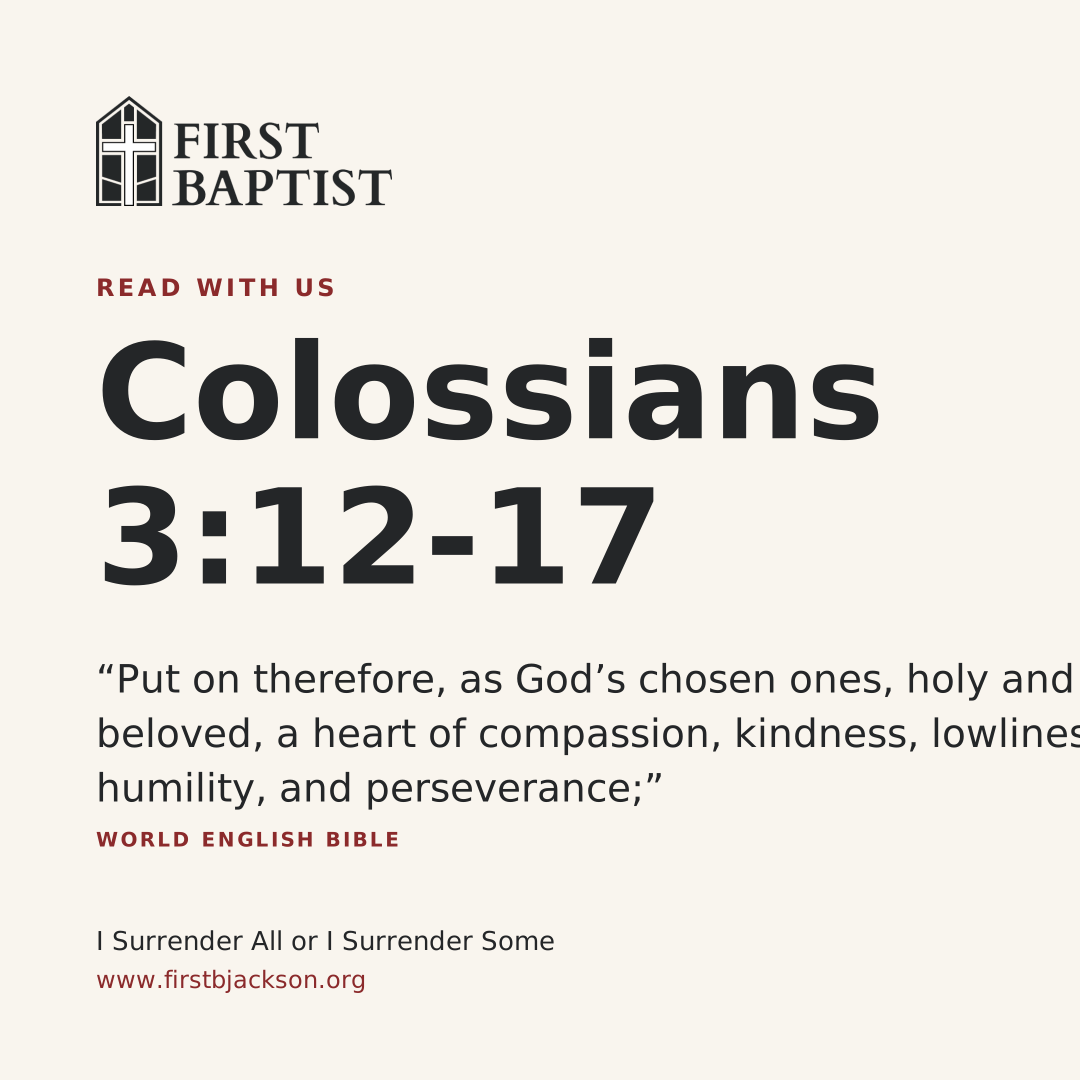
12 Put on therefore, as God’s chosen ones, holy and beloved, a heart of compassion, kindness, lowliness, humility, and perseverance;
13 bearing with one another, and forgiving each other, if any man has a complaint against any; even as Christ forgave you, so you also do.
14 Above all these things, walk in love, which is the bond of perfection.
15 And let the peace of God rule in your hearts, to which also you were called in one body; and be thankful.
16 Let the word of Christ dwell in you richly; in all wisdom teaching and admonishing one another with psalms, hymns, and spiritual songs, singing with grace in your heart to the Lord.
17 Whatever you do, in word or in deed, do all in the name of the Lord Jesus, giving thanks to God the Father, through him.
Slaves obey your human masters with sincerity of heart fearing the Lord, doing work heartily as for the Lord
22 Servants, obey in all things those who are your masters according to the flesh, not just when they are looking, as men pleasers, but in singleness of heart, fearing God.
23 And whatever you do, work heartily, as for the Lord, and not for men,
24 knowing that from the Lord you will receive the reward of the inheritance; for you serve the Lord Christ.
25 But he who does wrong will receive again for the wrong that he has done, and there is no partiality.
The message in order, in a few minutes of reading.
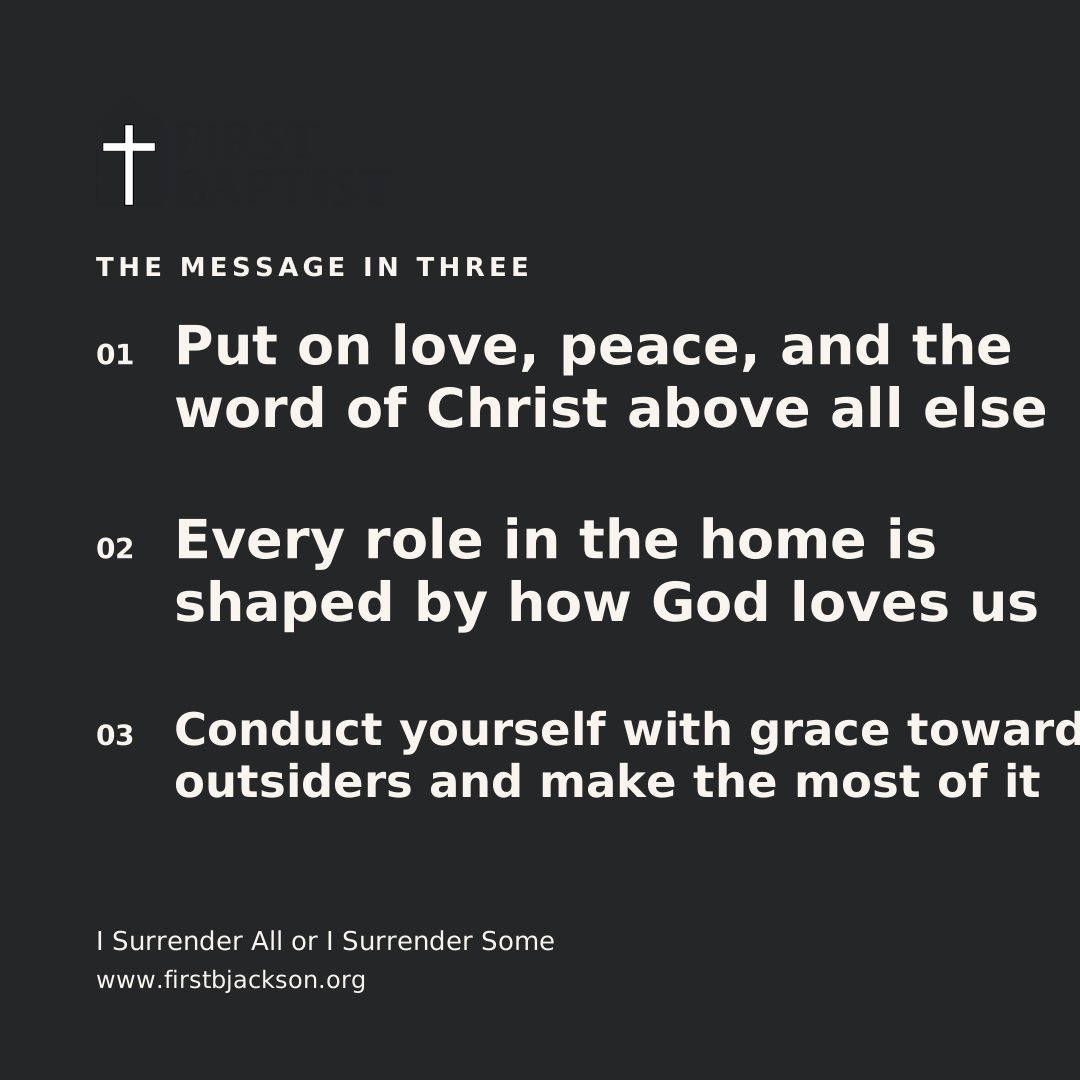
The message worked through Colossians 3:12-4:6, moving from the qualities that belong to people chosen by God into the specific household commands Paul gives to wives, husbands, children, fathers, slaves, and masters, and then outward to how Christians are to engage with people outside the church. The preacher connected all of it to a single thread: voluntary surrender to God and to one another, powered by the agape love that holds the whole passage together. The service closed with communion led by a newly ordained minister.
What was said
The passage opens with God addressing Christians as chosen, holy, and beloved, and the preacher paused there to let it land. Those are not words people always feel, but the text states them as facts about anyone who belongs to Christ. From that foundation, Paul issues a string of present-tense commands: be putting on compassion, kindness, humility, gentleness, and patience. These are not occasional postures but ongoing ones, worn the way you put on clothes.
Forgiveness sits at the center of that list, and the preacher pressed on it. The standard given in the text is not a personal threshold but a borrowed one: forgive one another just as the Lord forgave you. The engine behind that kind of forgiveness is agape, the self-effacing, others-focused love the passage calls the perfect bond of unity. Without it, the other qualities on the list have no fuel.
From there, the preacher moved to two more commands that close out verse 17: let the peace of Christ rule, and let the word of Christ dwell richly. He acknowledged that some people in the room are dealing with circumstances, health, job loss, or spiritual weight they cannot get out from under, and he held out the peace of Christ as genuinely available for those situations. The word dwelling richly, he said, should be so overwhelming to the system that it simply overflows out of a person's mouth.
At verse 18, the tone shifted. The preacher named the four household groups plainly: wives, husbands, children, fathers. He was careful to distinguish voluntary submission from subjugation, pointing out that the clause "as is fitting in the Lord" qualifies the wife's submission and that the commands given to husbands are heavier in volume across both Colossians and Ephesians. Three times in Ephesians, he noted, Paul says to husbands: agape your wives. The command not to become bitter against them is treated as a separate charge, not a footnote.
The commands for children and fathers were read together. Children are told to obey in everything, and disobedience to parents appears, the preacher noted, on the long New Testament lists of vices. Fathers are told not to antagonize their children so they will not become discouraged. The preacher described what a broken spirit in a child looks like when that command is ignored, and he said men's ministry talks often about the father wound precisely because this instruction gets missed.
The two remaining groups, slaves and masters, were kept in their first-century context. The preacher connected the letter directly to Onesimus, a runaway slave who he believes was carrying both Colossians and the letter to Philemon back to the church. He did not minimize the horror of the institution, saying plainly that he believes Paul hated it, but he read Paul's instructions as pastoral guidance for people inside a situation they could not immediately leave. The master who grants justice and fairness is reminded that he also has a master in heaven, and the preacher said every wrong ever committed will be either justly condemned or mercifully forgiven.
The final section pulled all six groups back together under shared commands: devote yourselves to prayer with an attitude of thanksgiving, and conduct yourselves with wisdom toward outsiders. Speech toward people outside the church, the text says, should always be seasoned with grace. The preacher read that as starting with unmerited favor, giving goodness away before anyone has done anything to earn it, and trusting that the mystery of Christ is powerful enough to work through that kind of humility rather than through argument.
Touch points
Things you could actually do this week.
Pick one person you have a complaint against and choose to forgive them this week, the way the Lord has forgiven you.
If you are a husband, ask yourself whether bitterness has crept into the way you treat your wife, and take one step to address it.
If you are a father, think of a specific way you may have been antagonizing or discouraging your child and go out of your way to encourage them instead.
Let the word of Christ dwell in you by spending time in it daily, and let a psalm, hymn, or song of gratitude be part of your week.
In every conversation with someone outside the faith this week, lead with grace and kindness rather than argument, and look for an opening to share what Christ has done in your life.
Doing a Bible study?
Here is a guide we have prepared for you: the passages
in order, questions for the group, and room to write.
The sermon talked about putting on compassion, kindness, humility, gentleness, and patience as things chosen and beloved people wear. Which of those is hardest for you to put on consistently, and what gets in the way?
The preacher said 'he who is convinced against his will is unconvinced still' and that kindness, not argument, is what opens people to the gospel. Have you seen that play out in your own experience, either coming to faith or sharing it with someone else?
El mensaje partió de Colosenses 3, repasando primero los versículos 12 al 17 antes de llegar al pasaje que le incomoda a más de uno: el 18 en adelante. La sección recuerda que los creyentes han sido elegidos, llamados santos y amados por Dios, y que de esa identidad nace todo lo demás: compasión, humildad, paciencia, perdón mutuo y el amor ágape que mantiene unida a la iglesia. La paz de Cristo, se dijo, es lo suficientemente poderosa para gobernar el corazón en cualquier circunstancia, si uno la deja actuar.
Luego se abordaron los mandatos para esposas, esposos, hijos, padres, esclavos y amos. Se aclaró que la sujeción de la esposa no es sometimiento forzado sino entrega voluntaria dentro de una relación de amor mutuo, y que el mandato al esposo, repetido tres veces en Efesios, es amar con amor ágape y no amargarse. A los padres se les advirtió que no exasperen a sus hijos para que no pierdan el ánimo. El pasaje sobre esclavos y amos se leyó en su contexto del siglo primero, ligado a la historia de Onésimo, el esclavo fugitivo que llevó la carta a Colosas. El punto central fue que, sea cual sea la situación difícil en que uno se encuentre, el llamado sigue siendo hacer todo como para el Señor.
El sermón cerró con la invitación a orar sin cesar, a caminar con sabiduría ante quienes están fuera de la fe, y a hablar siempre con gracia. Se tomó la Cena del Señor como recordatorio del sacrificio de Cristo y anticipo del banquete que espera en el cielo.
---
Pasajes bíblicos mencionados
Colosenses 3:12-17
Colosenses 3:18 - 4:6
Efesios (mandato de sumisión mutua y amor ágape entre esposos, citado varias veces)
Filemón (contexto de Onésimo)
Read the full transcript4,251 words
Speaker 1I mentioned Blake in the booth last week. There's his favorite passage. I used it in his wedding, you know, 12 through 17 was in his wedding and up here in the baptistry, it was that and he went around and he went around saying, I just love Colossians three. I just love Colossians three. I just love Colossians three and about six or seven months ago, he said, 18 bothers me.
One through 17, he had no problem with whatsoever. He said, 18 bothers me and I thought, well, you take it. All, right? We take it all and so here we go. We're going to go.
I'm on double back. I I sometimes say it's like keeping a wet edge when you're trying to paint something. You want to keep a wet edge so you don't have dry stuff in there and so I'm going go back and hit 12 through 17 before I get to 18 but here it is. Colossians three twelve four through six. Now, when I I start really honing in on the slides and normally, I have 80 slides.
I know that sounds like death by PowerPoint. That's what it felt like in seminary to me but I usually just change a color or two but 80 is about average. That's almost every time. Last week, I said, listen fast because it was a 100. I want you to see this morning.
This is my screen on Thursday morning when I got into the office. There were 44,754 slots. I don't think I preached that many in my whole life. It scared me when I saw that. So, I'm going to abbreviate the sermon today.
They're less than half of what I have as normal but I want to start right here and having just sung, I surrender all. That's a perfect lead into this and I didn't ask for it but it's either I surrender all or I surrender some. You know, I surrender all. So then, and just let this wash over you, okay? This is scripture.
This is this is God's good news and his good word and he says, so then, as those who have been chosen of God, holy, though you were not holy, God has called you holy. He's made you holy, imputed the righteousness of Christ to you. As those who have been chosen of God, holy and beloved, do you feel beloved? We don't always feel it but I want you to take this in. This is what God is saying of you, Christian, alright?
As those who have been chosen of God, you're holy and you're beloved. Be putting on a heart of compassion. Be putting on a heart of kindness. Oh, it's the kindness of God that leads to repentance. We see so many people trying to argue folks into the kingdom.
He who is convinced against his will is unconvinced still. You can't argue somebody in. You can be kind to them especially when they're not expecting it. Be putting on a heart of compassion. Be putting on a heart of kindness.
Be putting on a heart of humility, real humility, not false humility. They can look the same sometimes, right? But real humility recognizes that, hey, chosen of God, me? Really? Holy?
Me? Beloved? Me? Yes. Thank you, Connor.
Be putting on a heart of compassion, of kindness, swim in this for a minute. Humility, gentleness, and patience. And be bearing with one another and it takes patience to bear with one another. Be forgiven each other. Whoever has a complaint against anyone inside the family, inside the body, inside the church, outside everybody.
It says, forgiven each other. Whoever has a complaint against anyone. It is the kindest thing you can do to forgive somebody, right? Whoever has a complaint against anyone, just as the Lord forgave you, so you must do also. Imitate, be imitators of God.
He says in Ephesians, right? Be imitators of God therefore, as dearly beloved children. So, you must do also. In addition to all these things, be putting on love and I mentioned last week, Agape. Agape is self effacing others focused kind of love.
That's the way that God loves us. When it says, to forgive one another just as God in Ephesians, it says, in Christ has forgiven us. If we're doing that in that same way, it will be powered by the most powerful thing in the whole cosmos and that is the love of God. The agape self effacing, others focused kind of love. In addition to put all all these things, be putting on agape, which is in itself the perfect bond of unity.
That's what keeps us together, and peace of Christ rule. That's the third person command I mentioned last week. Peace of Christ rule. Now, we changed it in English to say, let that happen because you do kinda have to allow it, okay? The peace of Christ is powerful enough to rule in your heart if you will let it.
I know that there are some of y'all who are struggling with all kinds of stuff. Circumstances that are present and it's not from some sort of physical malady or spiritual malady. It's just the circumstances are present. Whether it's health or well-being or loss of job or anything like that. I know some of y'all are struggling with that.
Some of y'all are struggling with spiritual stuff that you feel like you just can't get out from up under but the peace of Christ is available for that situation, I promise. Peace of Christ rule over all of these situations. Now, y'all let that happen. Okay. Y'all were called into one body.
Let that peace of Christ rule in your hearts and and be thankful. Isn't it great to belong to the family of God? Ain't it great that he's still accepting new folks in? It's not just me, my four, and no more. It's this and growing.
And word of Christ dwell richly right here. The word of Christ dwell richly in these hearts and in these lives. May they have intake that is so overwhelming to their system that that must overflow and come out of their mouths. Out of the overflow of the heart, the mouth speaks. God, would you allow your word to dwell richly within each one here present and every family that they represent?
Would you just ooze out of them? The word of God. Which is able to lead to repentance and it's the kindness of God that puts it there in the first place. Let the word of Christ richly dwell within you. With all wisdom.
Teaching and admonishing one another with Psalms and hymns and spiritual songs. Can I say, did y'all hear anything this morning that was was encouraging to you? Before I got up here, right? Psalms and hymns and spiritual songs. We're all, it's amazing what they can do.
I cried at a gas station in Alabama singing the goodness of God. I think of it every time I hear it, I just burst into tears about how faithful God is and that song needs to get in there and just reverberate, right? It's so good. Psalms, hymns, spiritual songs, and be singing with thankfulness in your hearts to God. I I sang all night last night.
I'm surprised I still have a voice this morning. I sang for five hours coming home from Salt Lake. Too late. It was amazing. Just singing and having a ball.
Yes. With thankfulness and your hearts to God. Whatever it is that you do, whether it's in word or deed, do everything in the name of the Lord Jesus Christ. Giving thanks through him to God the father. God, thank you.
Thank you for all of this. Thank you for your word. Thank you for your peace. Thank you for this family of God. Thank you for the body of Christ.
I thank you that you're working in it. You're working through it and I thank you lord that when we surrender all to you, you will cause us to flourish. And it's the long game. In Jesus name, I pray that you'd occupy our hearts, that you'd occupy this space, that you'd fill it and our homes with your peace, with your word. In Jesus name, amen.
Now, that's up through 17. When we get to 18, there are imperatives for four groups and it starts boom right there. So these imperatives are commands and it starts, wives, husbands, children, fathers. There are actually two other groups. I'll get to them in a minute but this is the one for us, for our day.
This is the most common for most of our lives. This is groups of people, wives, husbands, children, fathers, and here we go. It's Colossians three eighteen says, wives, husbands, children, fathers, pay attention. Here we go. Wives, be subject to your husbands.
This is not subjugation. It is a voluntary submission. And let me just say, it's to your husband. Y'all picked each other. Okay?
You made the you made the promises, and you don't have to do that. It's not a necessary thing you have to do, but when you do it, you are setting yourselves into a relationship. I'd say Ephesians 21 says it's a mutual submission and then, there's an order that right out of the box, Paul says, wives, be subject to your husbands as is fitting in the Lord. Husbands, love your wives and do not become bitter against them. Two different commands.
Love your wives. Agape, your wives, and don't become bitter against them. Two different things. If you go back to the Ephesians passage and you look at all the commands for the husbands, it's three different times. It says, love your wives, love your wives, love your wives and it's always agape, right?
It's good. Husbands, love your wives. Don't become bitter against them. Children, obey your parents in everything for this is pleasing to the Lord. It's that big slide that I put up when I was doing the 12 steps.
It's all the different vices listed in the New Testament. Do you all remember that? It's little bitty words and it spread across this. It's a huge thing. All the different lists.
Disobedient to parents is on that list. Children, obey your parents in everything for this is pleasing to the Lord and fathers, don't end up double duty here. Husbands, get called out twice. Husbands, fathers, don't antagonize your children so that they will not become discouraged. There is so much talk in men's ministry about the father wound and I think that if we would take this to heart and surrender all, I think leave it up to the uncles to antagonize.
Okay? You'd be encouraging. Alright? Fathers, don't antagonize your children so that they won't become discouraged. Have you ever seen a broken spirit in a child where it just hits them and they go, ah, I can never do right.
Don't antagonize them. That's it. That paragraph. That's the one. That's the hard one and it's only hard because of everything around us all the time, right?
Yeah. It's because of where we live. It's the culture that we live in. Jesus constantly elevates women. Paul, I think constantly elevates women properly understood.
Lot of y'all read him as a chauvinist. I can't help that. He's saying, this is your reasonable service, people. This is the way for human flourishing. Husbands love your wives.
Don't become bitter against them. Wives, be subject. It doesn't say subjugated and it's not beaten down. As is fitting in the Lord. That clause.
Pay attention to that. Wives be subject to your husband as is fitting in the Lord. Not everything he says it does is going be right. Husbands, love your wives. Don't become bitter.
Children obey your parents and everything. I know there are plenty of examples of children that have terrible parents. I know that but this is kind of the norm. For human flourishing, this is the way it ought to be. If a husband is loving and keeping away bitterness the way he's supposed to, he's easier to listen to and is easier to obey.
If he's not antagonizing constantly, he's a lot easier to obey. Pay attention to. Even love. Reciprocate. There are two other specific groups, and I sometimes have said when we get the stuff about slaves and masters, say, hey, to bring it into our current context, we can say employers and employees, but it's not really the same thing.
You can take some of the truth of this and say, well, when I'm at my job, ought to give them my give them my best. We can... We'll get to that in a minute. But slaves and masters at at this time, you could start out life and it didn't have anything to do with your race. It didn't have anything to do with, always, with your nationality, anything like that, you could end up in debt so bad that you sold yourself into slavery.
And then, you had a master, and you had to do the bidding of the master. So these two groups, I'm going to go back first century slaves and masters here. And the reason I'm sticking to this this time is because Colossians, I believe, was written primarily because of Onesimus who was a runaway slave. And he was going back with a two letters in his hand. One of them was the letter of Colossians for the whole church and the other one was Philemon.
Sorry, I'm from Georgia. That's the way I pronounce it. Philemon, Philemon. Philemon was an individual and he was a slave owner. He was a master and a runaway slave is delivering this letter back to his church.
That's where the rubber hits the road. That's where things get real. A lot of times people say, well, Paul was always writing to a problem. He was all... Not always, but a lot of times he was writing toward the problem.
He was trying to clear up something or confront some sort of sin. In this case, here we go. Let's just read it. Let's see what he says. Slaves, obey.
Oh, don't all of us want to do the slave rebellion? I I think that there's something in our hearts especially as Americans and after the civil war, and the more we study, the more we read, we just want to sit with it and we go, oh, it's always right to rebel and stand up against. But that's... In this time, if you rebel against the master, do anything against the master, he's got the right to take your life from you. Literally, it's part of the law.
A master could kill his slave. So he's saying, in the midst of this institution that I believe Paul hates, slaves. Obey obey those who are your human masters in everything, and not just with our service as people pleasers, but with absolute sincerity of heart, fearing the Lord. Well, we just heard that in 17, didn't we? Whatever you do in word or deed, do it all as if unto the Lord.
So he's doubling back on that specifically for his slaves. He goes on to say, and whatever you do, do your work heartily. Ask for lord. That's almost exactly the same thing. It's verse 17 and not for people.
Knowing that it's from the Lord that you'll receive the reward of the inheritance. Knowing that's from the Lord. Doesn't matter what you receive from the master. It is a difficult situation but knowing it's from the Lord that you'll receive the reward of your inheritance and it's the Lord Christ whom you serve. You find yourself in a difficult situation and your attitude compassion, kindness, humility, patience, bearing with, forgiving anyone, all of that is still reverberating in this.
For the one who does wrong will receive the consequences of the wrong which he has done and he will receive that without partiality. So, I think this is the place. This verse right here is where it goes back to everybody. It mentions six groups, wives, husbands, children, fathers, slaves, masters, and that. So, the one who does wrong, the one who steps out from up under this schema or see the consequences around what she's done with that without partiality.
Masters, grant your slaves justice and fairness. Does that sound anything like slave owner to you? Are they really focused on justice and fairness? In my mind, they're not, but this is what Paul is requiring of them. This is what I believe God is requiring of those at this time.
Masters, grant your slaves justice and fairness. Why? Knowing that you also have a master in heaven. So, it's alright with the world. Oh, y'all watching this for crying out loud.
It's alright with the world? No. No. No. But is there one who will make it right?
Yes. Is there one who has the authority whether people are listening to him or not? Yes. Every sin ever committed will be either justly condemned or mercifully forgiven. Everyone of em.
Masters, grant your slaves justice and fairing. Knowing that you also have a master in heaven and then, devote yourselves. When it says devote yourselves, I don't think he's talking just about masters right there. New paragraph. I think this is where we go all inclusive.
So, wives, husbands, fathers, children, slaves, masters, y'all, all of y'all, you're Christians. Be devoting yourself to prayer. In fact, y'all be keeping alert in it with an attitude of Thanksgiving. This is better than anything the world has to offer. Devote yourself to prayer.
Keep an alert in it with an attitude of Thanksgiving. Praying at the same time for us as well. That God will open up to us a door for the word. He's sitting in prison. Pray that he opens up a door.
He had sat in prison before when God literally opened the door, you know, and he stayed back because he had ministry to do. Praying at the same time for us as well that God would open a door for us for the word. Y'all be praying so that God open a door for us for the word so that we may proclaim what? The mystery of Christ. The mystery of Christ.
There's a way that seems right to a man but in the end, it's the path of destruction. The mystery of Christ is a mystery. We don't know exactly how it works, but but we do know that it works. And so getting our head, Jesus, in the right position, and then listening and obeying. That God will open to us a door for the words that we may proclaim the mystery of Christ for which I've also been imprisoned.
Y'all know that. That I may make it clear and the way that I ought to proclaim it and it there is the mystery of Christ. There are all kinds of different plans for sharing your faith and evangelism and there are tracks and there are all kinds of different ways of doing it but honestly, if you let the mystery of Christ sit right there and you go, I love this. It's amazing. It changed me from the inside out Amen.
And it's power is available to anybody who will take it seriously. I know that God works through his kindness and I know he works through our humility. So, if we don't beat folks up with the gospel and we don't belabor absolutely everything for our own advantage, okay? That's the thing. When we look at the list and it's, oh, I don't like that.
I don't like the way that sounds. If we look at it for what my position is, I am a husband and I am a father. I'm to love my wife and never become bitter towards her. And I'm not to antagonize my child. I mean, granted, here, I'm a pastor, I'm an elder, I'm all that or this sort of other stuff.
It has some other stuff that goes with it but none of them require lording over anyone. And so with all the humility that we can muster, I think we need to concentrate on the mystery of Christ. And we just need to let the word dwell richly within us and let the peace abide with an attitude of gratitude. And this, I think, is the outlet of for that. Now, you all be conducting yourselves with wisdom towards outsiders, making the most of the opportunity.
Your speech must always be with grace, Unmerited favor. Start out with unmerited favor. They don't have to do anything to earn your goodness. Right? Just go ahead.
Give the goodness away. It's good. Your speech must always be with grace as though it's seasoned with salt so that you'll know how you should respond to each person. Can I just say we often fail in this? I'm I'm thankful for you, Connor.
Come on, buddy. I love you. Amen. Amen. I got to do Connor's dad's service.
Oh. His memorial service and he loved his dad and took him to breakfast one morning at Bubba's and the waitress came up to the table and said, hey, can I take your order? And she's, he said, he did my dad's service and she said, he did my wedding. Thank you, Connor. Man, that's good.
I needed that. We're going to go into a time of communion and I'm looking out and I'm seeing people out of love so much and I'm seeing folks who who dipped one foot in and I'm seeing folks who kind of moved over a little by little and they they're 100% all in and it's just overwhelming me because all of us start as outsiders. All of us do. If we'll conduct ourselves with wisdom and humility towards outsiders and make the most of every opportunity. Start with grace and peace.
Start there and stay there. We'll know how to respond to each person. I'm going turn over to Vance. So last Sunday night, we convened a little Presbytery Council or an ordination council and as the elders of First B and a few more, we ordained Van last week to gospel ministry. Thank you.
And I do things pretty much the same way every time and he's going to do communion different this morning and it's not going to split the church, okay? So, it's just the way it is. I'm going ask the band to come back up here and we are going to do a more official ceremony with with more congregational input, more congregational ceremony eventually but I'm going to play the bass and I'm going to pray before we start. Lord God almighty, thank you for Van Jones. I thank you for Van's dad being able to be here last Sunday and this Sunday.
I thank you lord for the way that you're moving through your word in our hearts and I pray that it would change us lord rather than having us bend it. I pray that it would bend us and it would bend us to do your will and your way. In Jesus name, lord, I pray. Amen. You can explain however you want to stop still.
Speaker 2He's giving me permission to pass the elements together. Essentially, no, but it seriously, in all humility, I'm so thankful to be here really and yeah the Baxter's and the Gates's thank you for coming up and y'all can come closer.
Speaker 1Cooked up.
Speaker 2We talked about all different ways we can distribute the elements, but that's that's... We don't want that to be a distraction. It's not about how we distribute the elements. Right? The whole reason that we can gather here and and the cup is to look at our savior, Jesus.
The mystery of Christ. We, the beloved saints, get to come together. If you have put your faith in Jesus and proclaim him as your king and your deliverer, you are welcome to this table with us today. You do not have to be a member of First Bee to partake. We will pass both the bread and the cup together slowly.
Don't be, don't let that stress you out. Don't even think about it and you can hold on to those until we reconvene upfront and and and partake in the elements altogether. Before we do that, let's pray. Lord, we are sinners that come to you and we get to take this bread and this cup to remember that you paid the ultimate sacrifice out of love and obedience as you came from heaven to Earth in the form of a slave to do what we could never do and then you have risen and you are exalted and we exalt you today. We worship and proclaim your name and we believe in your word and we are so thankful that you love us so much that you've invited us to your table.
A little glimpse of what we have to look forward to in heaven at the feast when we can see you. In Jesus' name. Amen.