Referenced to show Paul calling the Corinthians immature
1 Brothers, I couldn’t speak to you as to spiritual, but as to fleshly, as to babies in Christ.
2 I fed you with milk, not with meat; for you weren’t yet ready. Indeed, not even now are you ready,
3 for you are still fleshly. For insofar as there is jealousy, strife, and factions among you, aren’t you fleshly, and don’t you walk in the ways of men?
Quoted at length to show teachers are like builders who must build carefully on the foundation of Christ Jesus
10 According to the grace of God which was given to me, as a wise master builder I laid a foundation, and another builds on it. But let each man be careful how he builds on it.
11 For no one can lay any other foundation than that which has been laid, which is Jesus Christ.
12 But if anyone builds on the foundation with gold, silver, costly stones, wood, hay, or stubble;
13 each man’s work will be revealed. For the Day will declare it, because it is revealed in fire; and the fire itself will test what sort of work each man’s work is.
14 If any man’s work remains which he built on it, he will receive a reward.
15 If any man’s work is burned, he will suffer loss, but he himself will be saved, but as through fire.
16 Don’t you know that you are a temple of God, and that God’s Spirit lives in you?
17 If anyone destroys God’s temple, God will destroy him; for God’s temple is holy, which you are.
Quoted to show that leaders are judged by God not by us, and judgment of motives should wait until the Lord comes
3 But with me it is a very small thing that I should be judged by you, or by man’s judgment. Yes, I don’t judge my own self.
4 For I know nothing against myself. Yet I am not justified by this, but he who judges me is the Lord.
5 Therefore judge nothing before the time, until the Lord comes, who will both bring to light the hidden things of darkness, and reveal the counsels of the hearts. Then each man will get his praise from God.
Quoted to warn against arrogance on behalf of one teacher over another, asking what anyone has that they did not receive
6 Now these things, brothers, I have in a figure transferred to myself and Apollos for your sakes, that in us you might learn not to think beyond the things which are written, that none of you be puffed up against one another.
7 For who makes you different? And what do you have that you didn’t receive? But if you did receive it, why do you boast as if you had not received it?
The message in order, in a few minutes of reading.
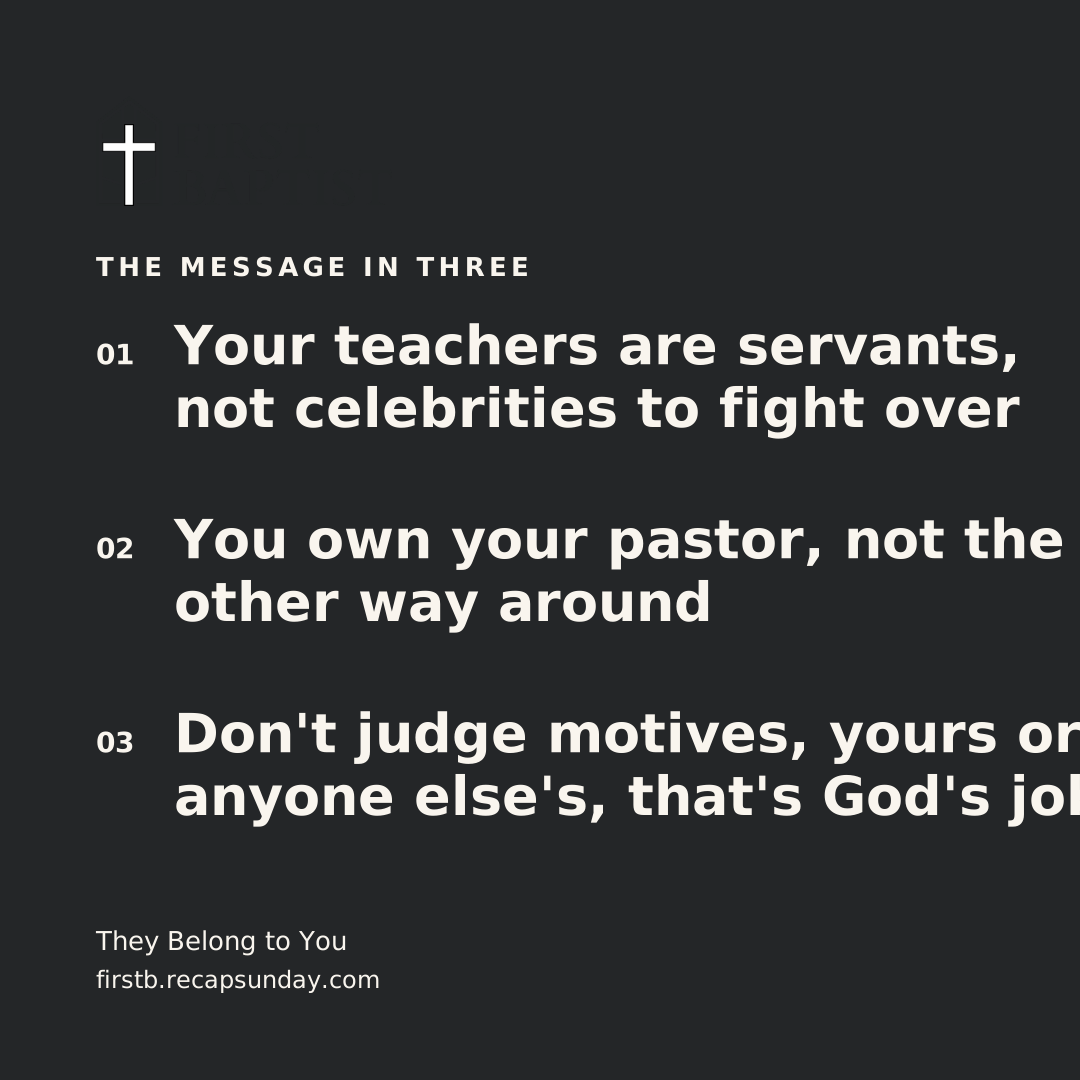
Jeff preached through portions of 1 Corinthians 3 and 4, addressing the tendency churches have to divide into camps based on which teacher or pastor they follow. He traced the problem from the Corinthian church outward to religious history and back to the local congregation, making the case that this kind of tribalism is both unbiblical and dangerous. The antidote, he argued, is thinking rightly about our teachers and about ourselves.
What was said
The Corinthian church was splintering into factions, each claiming loyalty to a different leader, Paul, Apollos, Peter, or Christ alone. Jeff pointed out that this kind of division is not unique to Corinth or to Christianity. He walked through how it has played out across religious history, from the splits within Islam after Muhammad's death, to the divisions within Mormonism after Joseph Smith died, to the ongoing rifts within Protestant Christianity over figures like John Calvin and Jacob Arminius. The pattern is the same every time, and it tends to get ugly.
Paul's response in chapter 3 is to reframe what teachers actually are. They are servants, specifically farmers and builders. A farmer plants and waters, but he does not make anything grow. A builder puts up walls, but he did not lay the foundation and he is accountable to the master for the quality of his work. The foundation is Christ, and God causes the growth. Our pastors deserve credit for showing up and doing the work, but they cannot be credited with our salvation or our spiritual growth.
Jeff pressed further on the servant image by pointing to verses 21 through 23, which say that Paul, Apollos, Peter, and all things belong to the congregation. The church owns its pastors, not the other way around. A pastor who answers the phone at midnight, who visits the sick, who makes himself available, is one who understands this. That accountability runs the other direction too, Jeff noted. A pastor who destroys God's people rather than building them up is accountable to God for it.
Moving into chapter 4, Jeff addressed how we evaluate our leaders. He said we can and should hold leaders accountable for their actions, citing things like financial misconduct or mistreatment of people in the congregation. But he drew a firm line at judging motives. Paul wrote that he did not even judge his own motives, and that the disclosure of what is hidden in the darkness belongs to God alone, at the time of judgment. Jeff applied that directly, saying that accusing a pastor, a politician, or anyone else of bad motives is a cheap shot we are not in a position to make.
The sermon turned to the problem of pride. Verses 6 and 7 ask, who regards you as superior, and what do you have that you did not receive? Jeff identified three forms this pride takes in church life: dividing from other believers over whose teacher is best, judging other people's preferred teachers, and nursing a private sense of superiority for having chosen the right one. He named names, including Alistair Begg, John Piper, John MacArthur, Tim Keller, and others, not to disparage them but to make the point that dividing over any of them is simply unbiblical, and that Calvin and Arminius, if we could ask them, would have no interest in the fights still being waged in their names.
Jeff closed by acknowledging that he has never really sensed that kind of superiority among people at First B, but invited the congregation to examine whether it shows up in subtler ways, in podcast loyalties, in reformed versus Arminian camps, in dispensational versus covenant frameworks. His point was not to flatten those conversations but to insist that they should never produce division from a brother or sister. Those teachers, living and dead, belong to the whole church. They are servants, not lords.
Touch points
Things you could actually do this week.
If you catch yourself judging your pastor's motives this week, stop and remind yourself that God is the one who examines hearts, not you.
When someone compliments something good you did, practice saying it was God who made it possible rather than taking the credit.
If you have been identifying yourself primarily as Reformed, Baptist, or by any teacher's camp, spend some time this week backing up and simply calling yourself a Christian.
If you have been holding back from getting more involved at church, reach out this week and tell someone you want to be part of the team.
When you hear someone judging another believer for which teacher or preacher they follow, gently remind them that those teachers all belong to the whole church, not to one camp.
Doing a Bible study?
Here is a guide we have prepared for you: the passages
in order, questions for the group, and room to write.
Jeff described the Corinthian church as gullible, highly educated, and morally out of control, and then asked how that compares to the American church. What do you think? Where do you see those same tendencies showing up today?
Jeff said that the more we put a pastor on a pedestal, the more we will divide over that pastor. Have you seen that play out, either in a church you have been part of or from a distance? What did it look like?
El texto de este domingo viene de 1 Corintios, capítulos 3 y 4. Jeff señaló que la iglesia de Corinto se estaba dividiendo en grupos según el maestro que cada quien prefería: unos decían seguir a Pablo, otros a Apolos, otros a Pedro. Ese espíritu tribal no es nuevo ni está limitado al cristianismo. Ocurre en todas las religiones, y cuando se deja crecer, termina en conflictos serios. La pregunta que nos plantea el pasaje es si nosotros hacemos lo mismo hoy, sea con pastores vivos o con teólogos que murieron hace siglos.
Pablo corrige eso recordándonos el lugar real que ocupan los maestros. Son siervos, no fundadores. Uno planta, otro riega, pero es Dios quien da el crecimiento. El fundamento es Cristo, y sobre ese fundamento cada maestro construye, pero tendrá que responder a Dios por cómo lo hizo, no a nosotros. Además, y esto puede sorprender, los maestros nos pertenecen a nosotros como iglesia, no al revés. Un buen pastor se pone al servicio de la congregación, como Ray lo hace con esta iglesia.
En cuanto a juzgar a nuestros líderes, el pasaje distingue entre juzgar acciones, lo cual puede ser necesario, y juzgar motivos, lo cual le corresponde solo a Dios. Pablo dice que ni siquiera se examina a sí mismo en ese sentido, porque el que lo juzga es el Señor. Eso aplica también a nosotros: cuando hacemos algo bueno, no hay que pasarse cuestionando si lo hicimos por razones puras. Simplemente hay que hacer el bien y dejar que Dios se encargue de lo demás. La conclusión es sencilla: lo bueno que hemos recibido, sea de Juan Calvino, de Jacob Arminio o de cualquier otro maestro, viene de Dios. No hay razón para enorgullecerse ni para dividirse.
---
Pasajes bíblicos mencionados:
1 Corintios 1:12
1 Corintios 3:1-3
1 Corintios 3:4-9
1 Corintios 3:10-17
1 Corintios 3:21-23
1 Corintios 4:1-2
1 Corintios 4:3-5
1 Corintios 4:6-7
Romanos 14:4
1 Corintios 12:2
Read the full transcript8,400 words
Good morning. It is 09:00. We don't know when we start on time, but we are today. You guys, you stand if you feel like it. We'll see what you feel like.
We're gonna do what a friend we have in Jesus. Thank you, guys. Van is gonna come up and do announcements. Before that, we should pray. We started out without praying.
That's like going through the first course without praying. We better not do that. Thank you, Lord, for our morning together. Thank you for our week together, Lord, and and the way that we live in community in this church. It's a rare opportunity to have fellowship all week long.
I pray we'd continue continue to avail ourselves of it. Be pleased with our service this morning, Lord, and our our, words, our response to your word, and the feelings of our heart and the words of our mouth, Lord, that they would make you happy this morning. Thank you for saving us in Jesus' name. Amen. Van.
Amen. Y'all can be seated. Yeah. I was back there chit chatting and
oh,
it's time for time to start worship. Welcome everybody. So glad you all are here. If you have never been here before and it's your first time, which I know some people right here, it's their first time. I'm not gonna ask you to stand up or do anything weird.
But there should be a card in front of your in the seat back pocket in front of you. Pick it up if you wanna be contacted, reached out to. We would love the opportunity to get to meet you and pray for you and help you get plugged in. If this is a church that you wanna get plugged into. If you have been coming here for maybe longer than I am old, so glad you're here this morning too and if there's a prayer request, you can use that card for the same thing.
Put it in the offering plate or you can use the box by the front door, drop it in there. We'd love to to get those and pray for you. You can also just come and say, hey, come you know, I need prayer right now and we can do that too. So, man, so thankful for all the stuff going on in the valley. One of the things is revival at the Rodeo grounds.
That happens tomorrow night. It's the third time. We're planning to do it just five Monday nights. So, in the local stands is where it happens. We pull a fifth wheel or a gooseneck flatbed and have a full band, preach a message.
It's really great. It's more of an evangelistic message. So, you have friends or people that are maybe just here for the summer and they maybe they work Sunday and you're like, man, I would love for them to worship in a place. Maybe they don't feel comfortable at church. That would be a really great place to invite them to come and worship with us.
And it's not just our church. There's a few other churches in the valley. So, it's another opportunity to just see our brothers and sisters in Christ that worship in other communities. So, come to that, bring people to that. First BBQ, if you didn't notice, I don't know how you wouldn't have noticed.
It's very clear. It smells. You can see it. First BBQ is happening at 10:00. It's it is so fun.
One thing this week that's a little bit different, you'll see a green picnic table with a big cactus next to it. That is our missions table. That missions table is for anybody who is interested in going to Costa Rica or Zambia or both, some people are going to both, in November. If you want more information, Brian McHughey and I will be over there at that green picnic table by the cactus. And we would love to give you some paperwork or answer questions, whatever.
Last thing is seeking truth in your twenties, happens tonight. It's another safe place like the rodeo grounds, a little bit more homey. At the McCuey's house, if you know somebody that that's in a a spot of wrestling with questions or doubt or whatever it is, or they just wanna come and study the Bible and have a free meal, then point them to the McKeebies house tonight at seven. Seven. Right?
06:30. Yeah. Not
seven. Can I clarify the age? So a lot of people have been asking me, is it a hard and set rule for the age? It's anybody that has graduate high school, young adult, twenties, young thirties, we don't care. It's just for young adults to find community.
55 and older.
Yes. 55. You are not welcome. Actually, you are to to mentor. Alright.
Let's pray and then we'll continue in worship. Lord, thank you so much for this morning. Just pray for my brother Jeff as he brings the word this morning. May you speak through him and use him as an instrument to to preach your word to us. Nothing but your
The new song to all of us, we learned it this week for VBS. We learned it off of YouTube. Well, you may have already known it.
I I know it. Yes.
AI taught us. But this song is the New Testament song. We're gonna learn all the books of the New Testament. It's not easy, and we're just gonna try to regale you with this. Casey?
Yeah. So this week, we had a a western theme VBS. Actually, if anybody is in the room that volunteered for VBS this week, can I have you stand? Can we just recognize all of the volunteers? There was a lot of people that helped.
Awesome. So if there's any kids in the room now, we're gonna have all the kids come up right in the front, and they can help sit teach this song to you guys. So any kids that wanna come up from VBS, come on up and help us do the song. You guys wanna come up? Come on, Penny.
Come on.
How many tall can I get?
I don't there's, like, four kids. Here we go. There's six.
Thank you. Good job. Oh, here comes some more.
Very good.
Come up. Come up, Silas. Okay. So this is gonna help you guys learn all the New Testament books as well. So the focus for VBS this year and hopefully the next coming years is we're gonna be doing songs with the kids that teach the gospel and teach important lessons like learning the books of the Bible.
So a lot of the songs that we did are are songs that they learned from from that we learned from early. Come on up, Robin. Okay.
Thank you, guys. Thank you very much.
You guys can sit down whenever you're ready. Thank you, Sherry, for being the conductor back there. We appreciate that. This song we sang once, we'll try it again. This is an old hymn set to newer music.
You can stand if you want.
All my life long, I panted for a drink from some cool spring that I thought would quench the burning of the thirst I found within. Well of water, ever springy, bread of life so rich and free. Unto well that Who else commands all the hosts of heaven? Who else can make every king bow
Van, if you come up and pray for the offering. Thank you, buddy.
Before you sit down, squish a little bit more if you can, if you have any room because we're we we do wanna try and get some more people seated.
That's right. Two to a seat.
And then you can see it. You can sit. You may be seated. Alright. Alright.
The ushers, please come forward as we as we pray. Alright. Bow your heads. Lord, thank you so much for this morning. Thank you for every single person in this room.
There's there's no mistake that any of us are here and yeah, we just we pray that you would use us for your kingdom advancement, for for magnifying your already great name, lord and whatever means that is for each of us individually and corporately as a group, lord. We pray that we pray that you would show us your way, lord, and that you would help us to walk in it. We love you so much. In Jesus name, amen.
One, two, three, four. We're singing holy holy. Thank you, guys. You can be seated. Kids, you can go downstairs to what awaits you.
K. Is that alright. Thanks. Alright. This is my first time to use this program up here, and I'm hoping that those words aren't too small.
Guys, today we're gonna talk we're gonna go through first Corinthians part of chapter three and part of chapter four. That's where we'll be this morning. Now, this is a subject that is peculiar to religion. This does not happen in other organizations. It doesn't really happen in politics.
It doesn't happen in the business world. It happens in religion. It is not limited to Christianity. It's every religion is subject to it, and it can happen in the church as well. When it does happen in religion, I'm just gonna set this over here.
It can get ugly. It can get bloody.
It
can get tribal. Wars have been fought over this issue, not just a few, but many many, and they are ongoing today. We continue to see fights over church tribalism, religious tribalism. Think of your whatever religion you want, and think of the divisions that are there, and what happens when they just go awry, when they go too far. That's what we're gonna talk about today.
Don't fight about which preacher you follow. Now that doesn't sound like a big deal. Anybody here fight with other believers over the fact, whatever. It's okay. I was kinda glued to that.
Yeah.
Now you're free.
There you go. Thank you. Any other That's it. Decaf. Alright.
Don't fight about which preacher you follow. Now I don't know anyone, honestly, I don't know anyone who fights over Ray McDaniel's wife pastor. You know, we don't feel all superior to everybody else because Ray is our pastor. I don't get that vibe from you, but it does happen over other pastors, both living and dead. Doesn't it?
And we become a little bit tribal. Pretty soon, we don't like this group over here, because they don't follow our leader. Right? And it goes worse and worse. The Corinthian now this is written to the Corinthians.
The Corinthian church was fighting. It was dividing over which leader was the best, over which leader most aligned with their views or their doctrine, or just their politics or their preferences. What was the Corinthians church like? I just want to talk about this for a second. Corinth was a city in Greece.
It's modern day Corinthos. You know, a lot of these cities that we look at in the Bible, they have crazy names today. They're totally different, but Corinth kept the old name, which we appreciate. It's in the Peloponnesian Peninsula. Predominantly, it was well, what was the Corinthian church like?
I've got some bullet points here. Now this was not easy for me to do. So predominantly, was a Gentile church. There was not a lot of Jewish believers there, but there was some, and they were very helpful to the church in giving them a background about what the Bible said. But most Corinthians were not very familiar with the Old Testament.
They had a lot of basic questions. If you go and look through Corinthians each chapter and say, what was the question they asked Paul here? You can get it pretty easy and you think, well, I knew that answer. You know. And and so they had some very basic questions, because they didn't know the Bible.
Number three, they were very idolatrous. Chapter 12 verse two says that when you were pagans, you went after all the idols. We know that in Athens, just I think it's less than 20 miles from Corinth. In Athens, it said they had a an idol on every street corner, everywhere, to every God, and even one to the unknown God. Because just in case we don't know exactly who he is, we're gonna have one to the the unknown God.
It was amazing. They were very idolatrous. They were in darkness when it comes to God, and they were very, listen to this, gullible, like primitive groups. Now, don't like that word primitive groups. I worked with a primitive group in Mexico.
So if you're uncomfortable with that term, I am too. But it is descriptive. Alright? And if if it's very remember, you have some primitive people in your own home if you're a parent. So you can understand that.
But I worked with a group that did not read and write. They didn't have a written language. They did not go to school, and they didn't know a lot of things. Now they worked hard and they learned things and they learned just like anyone else. I found them to be very intelligent in certain ways that we're not because we've gotten used to whatever.
But they didn't know about God. They had a lot of gullible ideas. Okay? So the Corinthians were gullible, like primitive groups, very educated, like university professors. And they loved science.
They loved philosophy. Lastly, they were very immoral. They're wild like Vegas. So they were gullible, very educated, and out of control. Paul called them immature in chapter three verse one through three.
How does that compare to the American church? Don't answer it yet. Let's keep going. Now, the Corinthian church was fighting and dividing over which leader was the best, which leader most aligned with their views. Look at Corinthians first Corinthians one twelve.
Here's what it says. I put it on board for you. Now, I mean this, that each one of you is saying, I am of Paul. And someone over here said, I am of Apollos. And someone over here said, I am of Peter.
And someone over here said, I am only of Christ. Right? They had little camps. They were dividing into little tribes. The Corinthian church was becoming tribal.
That's a popular word in America today, isn't it? In what context do we use that word tribal? Somebody blurted out. Who said politics? You had to bring it up.
That's where we use it today, isn't it? We haven't used that a lot, but we're using it now. Does that mean is that good? Does that mean we're positive? Woah.
We're becoming tribal. That means we're dividing more and more and more. K. The Corinthian church was becoming tribal over adherence to Peter, veneration of Paul, just adoration of Apollos, and some who says, don't listen to any man. Right?
You've got all four groups, and they're dividing and they're fighting. They fought over which leader was the the acceptable one. If allowed to continue this dividing the camps leads to a much larger fight. Now here we go to religion in general. That is common to religions and it's called a caliphate.
Have you heard of that word, a caliphate? There's a few of you that have been to The Middle East, and that's where we generally use that word, but it is not limited to Islam. Every religion can break up into caliphates. Now, if you've been to The Middle East or if you've watched the news, if you've kind of studied out the issue, you've gotten to know some Middle Eastern people, they're wonderful. But this caliphate idea causes them to break out into tribes.
And let me name you some of those tribes in Islam. Okay? I'm not picking on well, am picking on Muslims right now, but we're gonna get to more our neck of the woods. We're gonna get to America very soon. Shia, Sunni, I'm looking to Van and Lauren because they know more about this than I do.
What's the ones that Dervish?
Shiite.
Shiite. Did I say that? Shiite. Isn't that Shiite? Give me a break, Van.
Alright. Just say yes. And what are the Shias, the Shiites and the Sunnis do to each other? They kill each other.
Now
I don't wanna throw all the cold water on the Muslims. K? Because it happens in America too. If you have LDS friends, and I do, I have many, grew up on the LDS town, enjoy those folks very much, but they broke up into a caliphate just after Joseph Smith died. And they broke up and divided into four main groups.
There's a few other splinters now, but over who would succeed the dead prophet. And that's what happened to Islam. After Muhammad died, they all they said, well, I follow this this imam over here. I follow this imam over here. He should take over for the dead prophet.
It's exactly what happened to Mormonism, is that they broke up into four different divisions over whether they should follow Joseph Smith junior, Brigham Young, and the other guys that we don't know the names of. Has it happened in the church? It happens, doesn't it? We follow this, we follow that. Hopefully, we haven't gotten into too many wars over that.
If we go to war, hope we go to war against the Methodist because they don't, you know no. They're they're the nice guys. They're not gonna hurt us too bad. Right? I I don't want that to happen in the church, and Paul did not want happened to that happened to the church.
Poor Van and Lauren. You guys are on the hot seat this morning. Alright. The Corinthians already had a culture that venerated and divided over their teachers. Think Plato, Socrates, you're a stoic, or you're a hedonist, those kind of things.
They were very prone to this already, and very educated, so they could learn all about this stuff. Now, I'm gonna this is a quick I shouldn't even put this up here. This is my outline. The Lord helps us put our teachers in their proper place, because we should not be dividing over who is our favorite teacher, whether Ray McDaniel or someone outside this church that you listen to. Sober thinking about our teachers in chapter three verses four through nine, our teachers are servants.
The Bible gives us a picture of farmers. The next several verses, teachers are servants, a picture of builders. And then the last one, our servants are the picture of stewards. In the middle, don't boast in our teachers. We own them.
We'll we'll talk about that, how you own Ray McDaniel. And I can say that he's in Spain right now, but we do. And I'm gonna share how that is. This is what it says in verse four through nine. For when one says, I am of Paul, and another, I am of Apollos, are you not mere men?
What then is Apollos? And what then is Paul? Servants through whom you believed even as the Lord gave opportunity to each one. I planted, Paul says, Apollos watered, but God was causing the growth. So then neither the one who plants nor the one who waters is anything, but God who causes the growth.
Now he who plants and he who waters are one, but each will receive his own reward according to his own labor. For we are God's fellow workers, you are God's field. Now, this first part, our teachers are servants, they are like farmers. This section emphasizes what servants actually accomplish, what they actually do, and what they don't do. We're gonna emphasize both, what teachers do and what they don't do for us.
We've got to know both. Alright. Through our servants I'm gonna read that colorful first paragraph. Through our servants, we first believed in Christ. That's Ray, that's Van, our pastors.
Our farmer servants plant the gospel in us who believe, in God's field, that's who we are. And water it so it can grow. But they do, they actually cause the gospel to sprout. Now those colors are corresponding to colors in the text. Do they cause the cost the gospel to sprout grow?
Look at the red letters down there in the are there any red letters? Oh, right up top. But God was causing the remember that. What credit can we give our teachers and what credit can we not give them? Any credit that we can give our teachers?
They came here, they showed up. Right? And they and they and they went to work and hopefully they, you know, they answer the phone when you call, answer your email, come and see you when you're sick, things like that, and they share God's word with you. That's the main thing that a pastor does. We can give them credit for coming here and showing up, but they we cannot give them credit for our salvation.
We cannot give them credit for our growth. That is the Holy Spirit himself. We can't give them that credit. So our pastors, number one, they're not as important as we think. I am not here to denigrate your pastor, I'm here for us to think realistically about our pastor, so that we don't put him up on a pedestal.
Ironically, the more you put your pastor on a pedestal, the more you're gonna divide over that pastor. You ever been to a church where the pastor's so powerful? Oh, he's he's he's he's the only one I'll ever listen to. You ever in church like that? And people fight over that and and they divide and and God help us if one of their comes and pastors the congregation and splits it wide open because these ones wanna follow that leader and these ones don't.
That happens. And I don't want it to happen to us because where it leads is war. Alright. According to verse eight, the planner and waterer, Paul and Apollos, are one. Look at verse eight.
Now he who plants and he who waters are one. Let me go back to to where I was writing. They are not separate individuals whom we can follow individually. In other words, if you say, you know, I I this guy online, John Piper, I'm a what do they call John Piper followers? Piperites?
Be like, okay. Yeah. Have you heard of a a MacArthurite maybe? Someone who who likes John MacArthur. I like John MacArthur.
I like John Piper. I like Jack Hayford. Whoever you know, I like these guys. But they're not these individual pastors that we follow. They are part of our leaders in the church, and we esteem them.
They are one. Apollo Apollos, it's one. You can't split them up and follow one and not the other. So at first b, you can't follow John Piper, for example, and leave Ray McDaniel out. You can't do that.
They are one. John Piper and Ray McDaniel, they're one. K? So we can't split them up and say, well, I just follow this pastor over here, or I just follow Ray, and I don't listen to anybody else. There's there's no, you know, great thing to be said about that either.
We have to consider them one. This is the next section here. For we are God's fellow workers. You are God's field. Now we're gonna get to the builder part.
The the this is where our servants, our pastors, our builders. God's building. Verse 10, according to the grace of God, which was given to me like a wise master builder, I laid a foundation and another is building on it. But each man must be careful how he builds on it. For no man can lay a foundation other than the one which is laid, which is Christ Jesus.
Now if any man builds on the foundation with gold, silver, precious stones, wood, hay, or straw, each man's work will become evident. Who are these people building on the foundation? Teachers, pastors. Right? And some are building with gold, silver stone, others wood hay and stuff.
Okay. Let's keep going. Verse 13, each man's work would become evident for the day will show it because it is to be revealed with fire. The fire itself will test the quality of each man's work. If any man's work which he has built on it remains, he will receive a reward.
If any man's work is burned up, he will suffer loss. But he himself will be saved yet so as through fire. Do you not know that you are a temple of God and the spirit of God dwells in you? If any man destroys the temple of God, God will destroy him. For the temple of God is holy, and that is what you are.
Now our teachers are servants. They are like builders. Farmers first, now they're like builders. This section emphasizes what servants get paid. Alright?
Keep that in mind. Our builder servants build up or edify God's building on top of the foundation. What is the foundation? He can see on the pink words there. I laid a foundation, Paul says, and then later on where it says foundation.
For no man can lay a foundation other than the one which is laid, which is Christ Jesus. That is the foundation. What happens if someone tries to build on another foundation? There is no other foundation. Now we're not gonna build a church over some, you know, philosopher who died thousands of years ago in China or wherever.
We can't we can't that's not a foundation. No human on earth is a foundation. Only the God human, Jesus Christ is our foundation. So we have to build on that. All the different tradesmen working on the building must be careful how they build on God's temple.
Now look at these verses, the red words. Okay? Verse, let's see, 10, the end of verse, but each man must be careful how he builds on it. And then go back down at verse 12. You can build on it, but some of it's gonna stand withstand the fire, some of it's not.
And then you go back verse 13, each man's work will become evident for the day will show it because it's to be revealed with fire. Fire itself will test the quality of each man's work. We have to be careful as teachers and pastors how we build on God's temple. What happens to the man who rather than building up God's building, he tears it down? What says there, verse 17, the last verse, if any man destroys the temple of God, God will destroy him.
For the temple of God is holy and that is what you are. You are important to God. And the shepherd and the pastor had better be careful how he builds on the foundation Jesus Christ, how he builds the temple, how he builds you up, what he teaches you. There is some accountability there for a pastor. We tend to sometimes treat our leaders as kings, but rather they are our servants and they are accountable to God for what how they treat us.
We are the Lord's people. Verse 23 says that. Ironically, the more we venerate our teachers, I said it already, the more we'll boast in them. Our teachers, verse 21 through 23, are our servants. Let me read that at the bottom of the page.
So then let no one boast in men, For all things belong to you, whether Paul or Apollos or Cephas, that's Peter, or the world or life or death or things present or things to come. All things belong to you and you belong to Christ and Christ belongs to God. This section emphasizes who owns the servants. You do. It says it right there.
Whether Paul or Apollos or Peter or the world or life or death, they all belong to you. And you belong to Christ and Christ belongs to God. Now, we don't usually say that as pastors. You guys own us. What do we mean by that?
I mean, some of us were bristling a little bit, like, don't treat Ray like that. We don't own him. In what way do you own Ray? I can guarantee you, Ray believes that you own him because he acts like it. What happens when you call Ray in the middle of night?
He answers. It doesn't matter what time. Ray doesn't have that kind of boundary, you know. You own Ray and as pastors, own us. We belong to you.
We are here for you and we're ministering to you in the stead of Christ. You own us. We don't own you. Now that's important, isn't it? A pastor that owns you and manipulates you and and makes you do this and and and that that's not the pastor that we need.
We need one that we that he belongs to us. Pastors belong more than to each of us as as as people, but to the church. Pastors belong to the church. A good pastor does. A pastor that's, you know, got all these he's got so many boundaries that you can never get through to him.
I'm not sure that pastor belongs to us, but Ray does. He is an excellent excellent person at visitation. I've never seen a I don't wanna brag on this church or Ray, but I've never seen a pastor who visits like Ray does. Have you? Yeah.
Okay. So don't boast in us. We really do belong to you. That's not always easy for us to be owned by the church. Don't make it harder.
But whether Ray McDaniel, Chuck Smith, Alistair Begg, Van Jones, John Calvin, Jacob Arminius, or even Peter or Paul, you own them. They belong to us. We don't put them way up here. We may esteem them highly in certain ways, but they are our servants, and we have to think rightly about them or we'll be mean to other people. Don't boast in men.
Our teachers are servants, chapter four verse one through two, they are like stewards. Now, a steward is not a word that we use very often anymore. Have you ever had a fund manager? Or someone who manages your money? Or maybe you've had several through JPMorgan or or what?
I don't even know. Those are stewards. They are in charge of something very valuable. This section emphasizes how servants are evaluated or judged. You ever judged a pastor?
I'm ashamed to admit it. Saw one hand there. We'll discipline you later. Listen to that. I think all of us have judged judged pastor.
We've even judged Ray, haven't we, at times? And sometimes we've been unkind. How do we judge them in the right way? Let a man regard us in this manner as servants of Christ and stewards of the mystery of God. In this case, moreover is required of stewards that one be found trustworthy.
Steward has to be found trustworthy. He has been entrusted with very valuable things, And they must be distributed and invested in exact accordance with the owner's commands. I mean, you guys, if you if you've got a fund manager, you can tell them, I want this much and this. And they said, well, I put it in this because I like that company. It makes me feel good.
You're like, your face is turning red. Just do what I say with my money. The steward is not judged, however, by us. Let me say that again. The steward is not judged by us.
We'll back get back to that in a second. In the Corinthian church, they were fighting, dividing over which leader was the best, which leader most aligned with their views. They would exalt their favorite teacher, Paul, Peter, whoever, but denigrate your favorite teacher, John Piper. Give me a break. Guy's so short.
And they were divided into different tribes, Paulites, Apollosians, Peterists. Would the new church fall in the same trap as other religions? Alright. Here comes the antidote, chapter four. The antidote to church pride and division.
Verse three through five, proper evaluation of our leaders, and verse six through eight, proper evaluation of ourselves. I don't think we're gonna get past verse seven. So the others listen, if you're struggling with judging your pastor and being a jerk to him, start serving others. Become owned by the church like your pastor is. Start that process.
I've had about seven people in the last eight days come to me and say, I would like to get more involved in this part of the church. That person is seeking, those people are seeking to be owned by the church. One of them put it this way, I just wanna be part of the team. Praise the Lord for that. I think it's incredible.
And lots of you are coming forward. Some of you are just doing it on your own. It's incredible. A lot of people are doing it out there this morning. Alright.
The antidote to church pride and division, proper evaluation of our leaders, proper judging, proper evaluation of ourselves. Proper evaluation or judging of our leaders. When should we judge our leaders and what should they do in response? We're gonna talk about motives versus actions. Our leaders are not judged by us.
We can judge actions. If our pastor were to embezzle money from the church, do we just have to say, well, they're our pastor. We can't question him. No. We can we can talk to that pastor and say, well, you know, this is kinda criminal.
Right? So that's a good accountability that we do have to the congregation. We can't steal the money and get away with it. And Nick and I have talked about it. But we we can't do that, and we can't abuse people in the congregation.
That's something that that you do need to keep us accountable on. Sometimes, Nick and I, what one of the things we do is the the benevolence fund. It's enormous. And Nick and I, along with Diane, Geek, and Ray are tasked with giving that money away to people who need it and not to be defrauded as much as possible. If you send a friend to us and they come back and you said, how much they give you?
Well, it was it was this much. And it's not enough, come tell us. We want you to be a part of of of this benevolence fund. It's wonderful. But you can feedback.
We we need your help. Okay? But motives, what we'd rather not, Nick and I, for you to do is say, those guys are so chintzy. All they think about it's not even their money. We'd rather you not think about us that way.
That may not be the most appropriate it may be true, but it's it may not be the most appropriate thing. So we'll talk about motives versus actions. Our leaders are not judged by us, we judge actions, but by God. We can keep our judgments of leaders motives to ourselves. Romans fourteen four says, let me right over here.
Who are you to judge the servant of another? If you've got employees and I come and say, Casey, you got this guide, I can't stand him. He's doing this this this this. That's not really my place, is it? KC and Brian will judge that that guide.
I don't have anything to do with it. Who are you to judge a sermon of another? To his own master, he stands or falls and he will stand for Lord is able to make him stand. Here's the verses, verse three through five. This is gonna say some surprising things by the way about motors.
But to me, it is a very small thing that I'd be examined or evaluated or judged by you. Paul says, you're judging me. I don't really care. Or by any human court. In fact, I don't even examine myself.
Is that surprising? It's surprising to me. For I am conscious of nothing against myself. That's why he doesn't examine himself, by the way. Yet I am not by this acquitted, but the one who examines me is the Lord.
We don't judge our pastor's motives, God does. Therefore, verse five, do not go on passing judgment before the time, but wait until the Lord comes who will both bring to light the things hidden in the darkness and disclose the motives of men's hearts. And then each man's praise will come to him from God. We should talk about when it's appropriate to judge other people's motives. Right?
Put it on your calendar, Thursday. And when it's appropriate to judge our own motives. You ever judge your own motive? What does that look like? Usually, do something good.
Right?
Yeah. Yeah.
And then all of a sudden your conscious, oh, but I think I might have done that for personal glory or or or maybe I did that because I what you know, whatever. I don't think there's a lot of value in that. Just do the good thing. Don't don't sit there and worry, what if I was looking for my own you know, just do the good thing. Do the good thing.
Don't sit there and judge yourself to death. Not everybody struggles with that. If you struggle with that, the the old army chaplain Oswald Chambers called that morbid introspection. In fact, he got it from a different author. Morbid introspection, where you're doing good things, but then you're always wondering, That'll drive you crazy.
Don't get into it. Paul didn't get it. I don't even examine myself. What else does it say here? When is it appropriate to judge other people's motives our even our own?
When can we indulge in motive judging? Look at the red down here. Don't go passing judgment before the time. Wait until the Lord comes. When can we judge motives?
When we're dead. It's gonna be a great time. We can judge each other's motives all we want. Why? Because they'll be put up on the big screen and God will disclose the hidden things in darkness and the motives of men's hearts.
Then each man's judgment will come to him from God, each man's praise. Don't judge other people's motives. Now, is a very popular thing to do in the world today. Start listening. If you haven't started listening, just listen to the media and how they talk about politicians.
Sometimes they're accusing politicians of actual actions. If it's true, thumbs up for the media. Very good. We need our media to do that, don't we? Sometimes they're saying, well, I think this motive this guy's doing it for money.
This guy's doing it for what what do they call that presidential thing after your your legacy? Or or they're doing it for now, guys, that is a cheap accusation. If I say, John Hammond, that guy, everything he does for money, how could I know that? I could not possibly know that unless he told me. If he came up and said, actually, everything I do is for money.
You know, we can talk about it. Right? But I don't know that. And I don't know that about you. I can't say, well, your motive.
Yeah. You gave, but your motive I can't I don't know that. And I have no business doing that. And I have no business doing that to myself. When I am giving or whatever, don't second guess it, just give.
Just serve. Say, well, but I what if I just want to be noticed? Just do whatever it is that the Lord is having you do and don't worry about it. Alright? And don't worry about your pastor's motives.
God knows them and he's the only one. Ray doesn't know his motives.
Oh, yeah.
And I don't know his motives and you don't know his motives unless he tells us. Even then, we can have an overly sensitive conscience that says, well, I sometimes I do good things for my goodness. Don't ever let me hear you say
that. Alright.
When we do that? We do that when we're dead. Does any good come out of judging others motives or our own? Now sins, need to evaluate that. But motives, there's not much good that comes out of that.
Maybe you'll think of a time, you know, maybe you're doing something evil and you're trying to figure out your motive. Okay. I'm all for that. What makes us tick? Why do I do this?
Well, that's fine. But for for doing good things, don't judge your motives. Evaluate your teachers fairly. So how do we judge our pastors? We don't judge them this way, we don't judge your motives.
If you if you really have huge concerns about your past and you say, I think something's off with this guy. It'll come out if it needs to. Wait until then. And if not, it'll come out when we're dead, and then we won't really be interested. Now the proper judging of ourselves, verses six and seven, Says, now these things, brethren, I have figured it now by the way, this passage is gonna be hard on your ego.
It's hard on mine. It makes me feel pretty deflated. Alright? But maybe that helps me be filled a little easier with God. So let God fill that deflated space and puff you back up with himself rather than with ourselves.
Here's what it says. Listen to this. Now these things, brethren, I have figuratively applied to myself and Apollos for your sakes, so that in us you may learn not to exceed what is written. So that no one of you will become arrogant in behalf of one another against the other. For who regards you, this is hard, as superior.
I do. Right? I you know, we think of ourselves, well, I'm a little bit better than Emily, you know, or whatever it is. Not really. Who regards you?
I don't think anybody else regards us as superior. What do you have that you did not receive? If you got it, praise the Lord, he gave it to you. And if you did receive it, why do you boast as if you had not received it? In the context of, I follow the best teacher in the world and if you don't, you're not as good as I am.
Nobody else thinks about you that way. Oh, I followed Jack Hayford. He's so, you know, he's so godly, he's so spirit filled. I I like Jack Hayford. I don't make him my the leader.
Right? Who regards you as superior because you followed Jack Hayford? Guy's not even alive anymore. What do you have that you didn't receive? If Jack Hayford has taught you something wonderful, you just received it, and it was God that made it possible.
And if you did receive it, why do you boast as if you had not received, as if you detained it? That's what he's saying. We haven't attained anything. What we have that's good, it's God. You ever say that to somebody?
This somebody says, oh, I just loved the you know, what you did this morning in church, and you say, well, if it if it was good, it's God. If it fell flat, it's me. It's true. Alright. If it's good, it's God.
Pride on our behalf of our teachers takes three forms. Now these are little words. Division this is the main three that I see in the in the Christian church. Division between brothers and sisters over whose teacher is the best, whose teacher is acceptable. I don't even accept this other teacher over here.
Now by the way, there are there bad teachers in the church? Yeah. There's people building on the foundation and they're building garbage. They're hurting God's people. God will destroy that person.
You can have a conversation with your brother or sister about that. If they're found something who's taken them way over here, you're like, wow, what what's going on here? Help them. But of the of the of the teachers that are kind of within orthodoxy, and they're and they're good and stuff like that, if I judge John Hammond because he follows Tim Keller, I'm like, Tim Keller, oh my gosh. You know, are you serious?
That that you know, I'm I'm I'm saying to John that he's less than I am because of who he follows. How lame. Number two, judgment of the other person's teachers. Tim Keller, that guy? Don't don't let Tim Keller see this sermon.
Tim Keller. Is he really? Alright. I'm sorry. You believe that?
I guess I gotta follow the news a little bit more. And number three, arrogance over having chosen the best teacher for myself. I follow so and so. I follow Peter. Right?
That's the three main ways I see pride on behalf of our teachers in the church. That sounds harmless enough, but again, we will go to war for those guys and we must not. We have to nip it in the bud way down here at the low level of church pride. These things exceed what is written in the Bible. That's what that's what that passage says.
In other words, it's simply unbiblical to fight over our teachers. And it's a bit ridiculous, but we do it. Paul applied these figurative things, verse six, to he and Apollos. What things? The word pictures of number one, the farmer who plants and waters, but God does the real work.
Number two, the builder who has to be careful when he builds on Jesus foundation because he is accountable to God for what he builds. Number three, a steward who must be trustworthy, but will be judged by the master, not by us. Alright, friends. Little application time. Do we struggle with feelings of superiority because Ray is our pastor?
I really have never gotten that vibe from people from first b. And I've been an outsider first b for fourteen years before I finally came in. Right? But I've never gotten that vibe from first b people that we just esteem our pastor so highly and everybody else is garbage. But do we split into other tribes based on other leaders that we read or listen to their sermons or podcast?
Do we ever do that? Maybe. This is my favorite slide. Who are the Bible teachers we are feeling superior about today and maybe even splitting the camps over? You think of a radio preacher that that we do that to sometimes, our favorite one, Alistair Begg.
Right? Let's form our own Scottish camp. Here's who we def here's who we tend to divide over in the church, leaders who are dead, leaders who were dead a long time ago. John Calvin, Jacob Arminius. That's caused a huge rift in the church and it's my opinion that the rift is not helpful.
It's not helpful. And I don't think that the rift is over actual real problematic doctrine. I won't go into that. I don't have time. But we do split, and we split over whether we're we look at the Bible through a dispensational lens or a covenant lens.
If you don't even know what I'm talking about, praise God. I'm grateful. But whether it's John Calvin or Jacob Arminius who died in the fifteen hundreds, fourteen hundreds, fifteen, somebody said, thank you, Emily. Remember, those guys belong to you and I. They belong to the church.
They belong to us. They are useful to us, and they have taught us useful things, but we ought not divide over them. I don't think John Calvin and Jacob Arminius would be happy today if we divided with our brother. If you're calling yourself an ist and identifying yourself as that one of your primary, you know, I'm a Christian, but I'm a I'm reformed. I'm a Christian, but I'm a Baptist brother.
That's not a good place to be. Back up. Be a Christian. Be a Christ follower. You're gonna care about the other stuff.
And by the way, dead teachers don't care either. They just love Jesus. Jacob, Arminius, John Calvin, they are sitting at the feet of Jesus and they love him and they love each other. They sit right next to each other. So they belong to us.
Let's have the band come up. I'm gonna pray, and we're gonna sing the last song and be dismissed. Do remember that the first beat barbecue is going on outside that's gonna be ready for you. If it's not quite ready, it's worth waiting for. Lord, we thank you for this morning for our chance to get around your word, get around each other, and grow.
We love you, Lord. We love our pastor. We'll think rationally about him. We'll think rightly and fairly about him, Lord, and we'll continue to praise the Lord under his leadership, and we are grateful for it. I ask you continue to water us.
We continue to grow. Lord, be with us as we spend the rest of the day worshiping you. What a privilege. Thank you, guys.
Let no one caught in sin remain inside the lie up in word shame, but fix our eyes upon the cross and run to him who
Thank you all very much for coming this morning. Just wanna ask, Lord, that he would make his face shine upon you today, and you would feel it. You would feel that radiance. We are dismissed.