0:00
It's just interesting how how my wife and I kinda started working with kids. When we were 19, somebody came up to us and and asked, do you wanna work with kids in a group called Young Life? And Young Life is just an organization that outreach to kids, and so we said we would. My wife and I started dating while we were in the ninth grade. And here she is.
0:21
No. Not really. That's I'm joking. And my wife and I started dating in ninth grade. Our first date was when this Christian band came through town in Tulsa, Oklahoma, a group called Led Zeppelin and and and so it was so we dated and and we went off to different schools and and then came back and somebody just asked us a question which is kind of an interesting deal.
0:46
Never have I planned much in my life and but all it took was a question, do you want to work with kids? And we immediately jumped on it and said, well, sure. So, we started doing young life stuff. The church approached us and said, do you want to work for us? And I said, I'll never work for a church and ended up being there seven years because they ended up paying for my education.
1:06
I got my degree in finance with emphasis in real estate investments and then they told me they paid for me to go to law school and I did that for a semester and I quit because you're supposed to read and, I can't stand reading. I write books but I don't read books and, I read magazines, only if it has a lot of pictures and, but they've gotta be good pictures and so, are you guys like that? Do y'all read a lot? Is that what y'all start doing at this time of the year on is just start reading because I kinda said if I lived in this town, it was this cold. I'd be drinking a lot.
1:41
You know, just do people do that here. That's what I saw last night and and so and so anyway, so so we started working with kids and I said, I wanna do something a little bit different and we always had kids living with us that were struggling and having a tough time. Somebody would say, I don't know what I need to do with my child and so I would say, well, let him come live with us and and while I just spend some time with them and so I I did that when I was 19 living on an apartment and just taking kids in and and and just saying, I'll I'll work with them And so then my heart just kind of changed. Really, December of my first year of law school, a little kid that we had in our youth group was killed in an accident. One of these skateboarding kids, and then back then it was kind of a little bit different, but he kinda nerdy, had learning disabilities.
2:30
It's always mouthy, attention deficit disorder. Truly, one of those attention deficits had learning disabilities. He couldn't engage and I felt sorry for him named Darren Hinneger. And he was killed in a skateboard accident. And and and something changed in me and I said, well, this is what I wanna do.
2:49
I wanna start spending time with kids who are struggling. And so we moved to Branson, Missouri, lived at a Christian sports camp there. I was in the '72 pre Olympics, and so it it it worked. I I didn't do anything in the Olympics. I was against a guy named, this other mustache guy named Mark Spitz, and and and he kinda cleaned us up a little bit.
3:09
And and and so so I lived at this camp, and I was a area director for Young Life. And at the same time, we started a program to have kids live with us. After six years, I said, I wanna start something different. I don't wanna be as cold as it is in Missouri because it was always snowing, it seemed like, and and I just hated it. And I said, wanna go back to Texas where I was born.
3:30
And and so we moved to Texas and that was twenty seven, twenty eight years ago. And are people just trying to come in from everywhere? Is that what it is? And It's just creek. Yeah, creeks.
3:41
Great creeks. It's a 103 years old for Pete's sake. There's probably things in here you don't know about, you know, and so and so, so we moved to Texas and and, all I wanted was eight kids to live with us. I just thought, let's just let's just work with eight kids and we'll, you know, raise horses and and, spend time with them and and just work with these eight kids. Little did I know what was gonna happen over the next few years because somebody came and said, why don't we build another building?
4:09
Why don't we build another building? Why don't we do this? Why don't we start this and do this and do this and do this? And the end result of it is, over the last twenty seven years, we've had 3,000 kids live with us that come from every place you can think of and most of the kids that come with us, all but 2% of them are great kids, come from great homes, great backgrounds. They they get it.
4:35
They know scripture. They've been brought up in a great home. Something has spun out somewhere. And I don't know all the reasons for that, but I just know that something has. And the reason I always say that because the hardest thing that I have to convince people is is that one day your child or your grandchild could live with us.
4:52
And so I spend my time now traveling and doing seminars. I spend about two hundred nights on the road and and have over 5,000,000 miles with American Airlines, and they let me fly the plane occasionally. And and and so I travel trying to convince people, change some things, do some things different so you'll never have to send your child to come live with us. So anyway, so we we live in about a 150 acres and it's beautiful cabins that are all over the place. That that that's why it fit in.
5:20
I'm I'm staying in a little cabin. Where is it? The Cowboy Village which is great because it's quiet because nobody else is there. Evidently, they know something as well. Does anybody here own the Cowboy Village?
5:33
I love it. I mean, I just, I, what's that? We know. We know. Oh, they're good people, aren't they?
5:40
I highly recommend that place. It's unbelievable but it's quiet because really nobody's there except us and and that when we went got in there last night, I said, Sam, where is everybody? I mean, it's it's just a dead season now. Is that right? And and so so anyway, it's it's they're log cap instructors.
6:00
It's a beautiful place and all that stuff. Somebody approached me and said, you need to write a book. And and I as I said, I don't I said, well, I don't I don't all I write are fundraising letters. I don't write books. I just write fundraising letters.
6:13
And they said, well, why don't you spend some time writing a book? So here we are 12 books later, seven years later, and it's kinda surprised me a little bit. But I get into it. I got three projects going now. And I've always thought about different books.
6:27
I turned 60 this year and, I know that's hard to believe. And I've turned 60 this year. And and when I was in my twenties, there was a book that was written called I'm okay, you're okay. And and so when I was in my thirties, wanted to write a book called I'm okay, you're not. And and then in my forties, it was gonna be I'm not okay and neither are you.
6:48
In my fifties, it would be titled, I'm not okay and I don't care anymore. And now that I'm 60, I'm going, who gives a flip? And and so it just changed a little bit. But I do have two books going on right now and and, I I really got three that that I'm working on and then two titles that I'm kinda working on and and one of the titles is tasering kids God's way and, and so I think that may it's hard getting a published for a publisher for that. And then the other one's gonna be written more toward parents of middle school kids when when, you know, that you raise your kids and everything's perfect and good and they give you coffee mugs that say world's greatest mom and world's greatest dad and, you know, you just feel like you're perfect and and then all of a sudden, something in middle school changes.
7:36
And have you all seen that or feel that way? Well, it just changes. Well, I wanted to title a book called Tinker Bell Farted. And I think it has promise, don't you? Yes.
7:45
I mean, if you were going to an airport, can I say that in the church? Okay. Well, this is the holy place. This is not right here. Am I right?
7:53
Evidently, it's not because nobody's here. You know, but but but I so I I I'm in between those two spots of trying to figure out, okay, which one's gonna go? Anyway, and so so we did the book thing and and that's been kind of an interesting deal. Somebody came and said, you need to be on the radio and I'm going, I really don't like, Christian radio, except for a guy named Chuck Swindoll and, I've always listened to this guy. Do y'all have Christian radio up here?
8:20
Yes. Are we on the radio here? Are we? I think we are but but and and so so somebody said we need to do a radio program and and help families and I said, just don't know whether I wanna do that or not and one of our board members said, this is what we need to do And I said, whatever you say, sweetheart, we'll do it. So we started.
8:44
Yeah. And she was and and, you know, in Christian radio, it was aimed at a 42 year old woman. That's kind of the target, market of that. And and I said, that fits in perfect because the age of their kids are a certain age and so it works out well and so we kicked this thing off. Well, we've been told that we're on every Christian station there is except for K love.
9:04
We used to be on with K Love. Is K Love here? Yeah. You know, it's it's there was a John and and John and Sherry had the morning show and they've been dear friends and and they helped us get on K Love and then when they left, they pulled us off. But we're on about 1,600 stations now, which is kinda surprising to us.
9:25
And so there aren't any more stations for us to get on. And so we're taking it to country music. Thus comes in the country music awards and all the other stuff. So we're taking those sixty second spots, getting artists to introduce me on the stuff, and and so that's what we've been working on now. So the but the whole thing has been an unplanned deal.
9:44
Never have I said, okay. Let's do this, and then we can and then we can and then it's all been kinda let's just see what happens. And, and so so that's why I'm here. And, I I want you to know that I don't get paid for this. I don't get paid for my speaking engagements.
10:00
I don't get paid. We charge for it. We charge and somebody picks up the tab for me coming, but I don't get any of it. I don't get paid for radio, and I don't benefit from the sale of books. That always relieves men a little bit because men are always going, he's trying to get into my back pocket.
10:16
I'm not here to sell you anything. I'm not here to convince you that you need to send your kid to Heartlight one day in case somebody screws up. Heartlight's expensive. You don't wanna spend the money on that. And but you can do some things now that would change the way that you can engage with your kids so that you can make sure that you don't have to go that path.
10:34
And you guys have kind of a unique setting here because it's a tourist town. I know there's 270,000 people that come here during the winter months, which seemed a lot smaller. Yeah. Is it more than that? And then it's it's a million.
10:48
Okay. Then it's like 3,000,000 or 4,000,000 during the summer months. Yeah. Three, ten million, 20 if there's 20,000,000 people. There's a 100,000,000 people that come here during the summer months.
11:01
Yeah. Y'all keep bragging all you want, you know? But I was sitting there today with a counter watching cars go by and there weren't many and and so but I mean, you have some unique stuff going on here which means your kids are gonna be exposed to some things that they wouldn't be in another setting because people come here to party, they come here to have fun, and there's even an article written I don't know what magazine this is. Planet? Do y'all read that?
11:28
Oh, well, anyway, so, anyway but I think it's I think it it there's I I think the interesting thing, identity crisis when teens struggle to find a place in a party town. And I think there's some truth to it. And, there's a lot of truth because because you guys make money off of that attraction, you know, that that comes here and and it becomes a a fun place to be. So so, you know, I I I think it it it's a matter of going through and trying to think, okay. How do we engage differently with kids to offer something different so that they don't get to a point where they start spinning out?
12:05
I read it. You have 400 kids in the in the high school. Is that right? I read a story today and it's going on in outside of Denver, Colorado of a school that's having problems from eighth graders. Do you read it, Sam?
12:18
This is Sam Shealy. Sam is my man wife that travels with me. I don't introduce him like that in San Francisco or Toronto. And, but, but travels with me a bunch. But but it's an interesting article because it talks about eight through twelfth graders and they've started sexting pictures and it did you all read this?
12:37
And it's and it's hundreds of kids that are involved in it. It's become kind of the thing to do and you kinda go, well, my kids would never do that. Well, your kids are doing that And somebody says, well, no, no, not my kids. And I go, yes, your kids. Somebody goes, well, no, no.
12:54
My are any of y'all grandparents? Two people, three people? That's it? Four. Good.
13:01
Grandparenting is great, isn't it? It's a reward for not killing your own kids. And, my daughter comes up to me and she goes, dad, it's almost like you like them more than us. Is it that evident? And she goes, no.
13:17
I'm serious. No. Me too. Me too. You know, but I mean, it it's it's interesting to me.
13:22
Will your grandkids do that? Oh, absolutely. It's the nature of of our culture that's doing something different. We think about that. The sexual the sexualness of the culture, then you give a camera to every kid.
13:34
Do you think that the lack of connectiveness is gonna make a difference and and cause something in the lives of kids that they want to engage differently? And so there's part of it. You're gonna hear things where where now now we're hearing a lot that kids are are well, I think I'm transgender. I need to be transgender. I somebody sent me a deal this morning, and it was a an article on a mom wanting to be trans financial.
13:57
She says, I think I'm a rich person locked up in a in a poor woman's body. Will you send money to help me get out of this? You know, and and so I sent it to my wife and and, so she's posted it on Facebook and and already has like a billion, you know, likes on the thing and and because everybody knows she's that. And, but I mean, whatever kinda comes up, I mean, it's it's we've read about, you know, transracial, trans, fat, transgender. I don't know what the next trans thing will be, but there's always something.
14:28
And if we're not talking about kids cutting themselves or self harm or this this girl girl thing going on or the smoking pot, which is gonna be big because that's also was asking here. It's gonna come to your state as much and it'll come to every state. And where was the where was the I just saw this when I flipped through this for just a second ago, but you can sign up for and I know that nobody smokes pot here in this in this town. Am I right? Wyoming normal.
15:01
If you believe this, this, this, this, this, and please sign our petition to make this happen. I mean, it's it's everywhere. And the thing is we're not gonna get away from it. The Internet, we're not gonna get away from. Porn.
15:14
4,300,000 porn sites. I didn't know there were that many naked women in the world. And and I gotta make sure I look at everybody when I say that because because sometimes when I say that, I'm looking at somebody and they go, he knows I'm on a porn site. No. And and so I just gotta make sure that I look at everybody when I say that.
15:32
But it's it's it's interesting how how the world changes and it continues to change. And I think that that Hillary Clinton, if I don't agree with her on, I don't I don't know where I am politically anymore, but but she made a comment once that I thought was so accurate. She said that we're all evolving in some way to adapt to a culture that's different. Would you agree in some way? No matter what I embrace, I know I look at things differently than I did twenty years ago.
16:02
I mean, I've sat in a pulpit at a church making fun of gays, you know, by telling gay jokes at the beginning. Well, what would happen to you now if that happened? Some do y'all do that in here in Wyoming? I know you do. But, I mean, you'd be gotten rid of really quick.
16:23
You can't do stuff like that. I I get in trouble when I call somebody a stewardess. You know, I've been going, well, you can't say those words anymore. Well, can't say retarded anymore. I'm not you can't say midget.
16:36
You know, you can't I I I'm going, we're getting where everything is so critical that for free expression, now you can't talk about things. So I think what it does is start to limit the way we engage and we look at a culture that's changing, but we're adapting with it as well. And so the one of the key things is how do we adapt to the world so we become what we need to be to the world and not be sucked in by it and give up the standards and values that we hold to be dear. Would you agree? That one of the greatest challenges is taking what I know and believe to be true, the the scripture that I believe in, the authority of his word, the those things that I embrace and that that I would grab a hold of and taking those and building those into the life of my child.
17:23
You know, so that something gets passed on. Well, there's a little bit of difficulty going on because eighty five percent of kids, according to the Baptist Church, the LifeWay resources, Eighty five, ninety percent of kids are leaving the church upon graduation from high school. And you kinda go, okay, why is that? What is it that that's not transferring over to an age where we're having to start a lot of places over because then when kids when when these kids grow up and have kids, then they start coming back to the church. It's interesting to me and but there's a period of time that they're that they get kind of lost in the in the midst of things.
18:01
So how do we deal with lost people? Because I've I've just realized this, that that, I don't deal with rebellious kids. I deal with kids who get lost. And I and it changes the way that I engage with them. I know it does you too.
18:16
I mean, it's it's if somebody's being rebellious, that's one thing. Did I say something wrong? And there's more to come. And but it but there's if there's rebellious kids, you respond one way. But when I start to understand that they're lost, it's different.
18:33
And I don't know about you, but I help people when they're alongside the road and have a flat tire or something. I'll always pull over. And I also also have a concealed carry license and and I pretty much tell them, get away from the car and I'll change your flat because I'll shoot you if you try to hit me over the head with a crowbar or something. Do y'all have concealed carry stuff up here? I mean, you drive around up here.
18:56
Is is it open carry here? That's what I thought. You know, saw a guy downtown carrying machine gun walking around. It's kinda different for me but and but I just you know, and and the reason I probably pull over and help is because I've been on that road and had a flat and nobody stopped to help me. And so so I go after that.
19:17
And and I think if we begin to understand that a little bit more, it changes the way that we engage with our kids when we start to see something different. It's not so much rebellion as much as it's a child just getting lost. And your kids will get lost. You think? Gotta make sure I look at everybody.
19:33
Every kid will get lost at some point. Well, I can give you 3,000 families that that have said the same thing, that my kids would never get lost and they get lost. So somewhere understanding what's going on makes a big difference in the way that you approach your child or engage differently. Let's say this dear Georgia pastor that that is here by way of Mexico, you know, let let's say that which I think is kinda cool. And let's say that he walks in the back door and and he's sort of stuttering the speech and he goes back and forth to different things and he's and he's walking down just kinda coming coming right towards me and he and and he's moving toward me and he comes to the purity, puts his arm around me and he and he goes, Mark, and just just throws up all over my boots.
20:45
Most of you that go to this church will be gone. He's not gonna be here. Time to send that boy back to Mexico. Time for him to go to Georgia, you know, where he came from. Are you serious?
20:56
I told you any pastor with a beard would pull stunts like that. You know, I mean, you'd start being ridiculed. You let him have it. You go, I was his wife. I'd shoot him tonight.
21:06
You know, if I, yeah, I can't stand him, Benny. You'd be embarrassed. You'd leave the church. You'd go some place else. You'd you'd go, we're not putting up with that crap here.
21:15
Are you serious? And I go, woah. Woah. Wait. Wait.
21:18
Wait. Stop. Stop. Stop. He's not drunk.
21:21
He's having an aneurysm. And it looks the same. It looks identical, but it changes the way you respond to him. Every one of you in this room would run up here to help him in a heartbeat. You would be honored that that he called your name when he was at a time of need.
21:43
It wouldn't matter whether he threw up all of my boots anymore. It wouldn't it probably wouldn't even smell anymore. You go, it's no big deal. But you'd rush to help. And I think that's what happens with our kids.
21:56
We are rush we rush to judgment. And then we rush to judgment because I think we forget that we were at one time in our life lost. Weren't we? We forget that sometimes. I once was lost, but now I'm found.
22:11
And we forget that we're lost, and so it moves us to judgment. And so when you move to judgment, what does it do? It pushes them further and further and further away. And we'll talk about the judgment thing in a little while as we go through stuff tonight. But it's really interesting just how people perceive that but what it does to our kids because it's hard for our kids to accept the wisdom that we wanna share with them without them interpreting it as judgment in some way.
22:42
And so our good intentions are being taken as something negative and it pushes them away. So there's a way to engage differently and we'll talk about that just a bit. Some of the things that that we'll talk about, I'll look at and just say, you know, let's let's, just pick a couple of things that that would apply to your situation with your kids. And you'll learn some stuff about just concepts about about the shift that is coming up after middle school. You'll you'll hear about that and you'll go, okay.
23:11
I get it. There's going to be a major shift. And what this means is, moms and dads, you've gotta make a major shift. And if you don't, you're gonna have problems. There's there's going to be problems.
23:22
And and and a a quick one. Moms, you gotta quit this all the time. You gotta stop. You just have to stop. I mean, it just it works during the an early age of a child, but it does not work when they turn 12 or 13.
23:39
Your nagging will drive them nuts and move them to a point that they'll find some rest somewhere. You following me? Because the tendency is out of the goodness of our heart. We wanna do that. Don't you do that?
23:52
Don't I mean, don't we kinda as I mean, a woman speaks 75,000 words a day. A man speaks 25,000 on a good day. You know, and and they're just wired differently. Men get into fixing things. Am I right?
24:07
We can always fix things when your kids in that early ages one through 12. But when your daughter comes to you at age 13, she didn't wanna be fixed. And that's where men miss the hearts of their daughters. A son doesn't wanna be fixed because it means he's not a man. You know, so the tendency to fix things is not it doesn't work And the tendency always to correct things all the time, that doesn't work as well either.
24:35
And so it's just knowing that there's an impending change that's going to happen, and we'll talk about that here in in a bit. Here's one of the other things. I want you to pick this up, that that what your child is looking for more than anything else, excuse me, is wisdom. You think? Is wisdom.
24:58
They don't need more information. The reason your kid shuts down on you when you're talking And they get in the car after school and and they say, and you say to them, hey, how are you doing? Good. What went on in school? Nothing.
25:22
What do you have to do tonight? Nothing. What do you wanna eat? I don't care. Your child is worn out.
25:31
They're just worn out. They get in the car and at some point they just go, I don't I don't wanna have lengthy conversations. And we forget that sometimes the culture that they're in is far different than the culture that you and I grew up in. I mean, they are they're having to live in that world that you and I are glad we don't have to live in. I mean, think about it for a minute.
25:52
4,300,000 porn sites, everything I prayed for when I was a seventh grader. You know, the the fact I doubt that my wife in ninth grade had somebody calling her saying, here, send me some new pictures of yourself. And think think about the culture that they're living in. It started at 10 and 11 years old. I mean, just think about that.
26:14
The the thing that's going on in Colorado right now is that there's there's 18 year old boys that have pictures of eighth graders and ninth graders with child porn. And they're gonna get nailed, I mean, over this thing. So there's a part of it where you go. It's a culture that we don't wanna grow up in, but it's still the pressures that they have to live with. And sometimes I think what happens is that we overestimate our parenting skills, but we underestimate the effectiveness.
26:43
We we overestimate the effectiveness of our parent and we underestimate the influence that the culture is having on our kids. So as a result, we're always a day late and a dollar short to get to the point to engage with them differently. And so my point is that when we do go to them, we wanna make sure that we're sharing wisdom with them. And here's the difference. Wisdom is is the principles of right living.
27:08
It's just simple. It's a it's a very easy. You can find it in a number of places. It's in scriptures, throughout scriptures. Scriptures full of it.
27:14
But you can also find that in India any Indian, American Indian thing. You can find it in the Chinese. You can find it in the Torah. You can find it you can find it everywhere. There's always little bits of wisdom.
27:25
I I, for one, love Mark Twain. And, I think he's got so much wisdom wrapped up in other stuff. I just go, golly, that guy got it. And so much of it applies. And and usually, wisdom is is timeless.
27:38
It always applies. And so there's a part of it where kids are looking for wisdom. But if all we're giving them is more information, then they're gonna shut us out because they're looking for something different. Now hear this. I mean, I I've turned colors this this past few years.
27:55
Some of you have also, but you hide it well. And and others, it's just fallen out. But, but but I've turned colors, and it's interesting to me that during my twenties, I thought this youth ministry gig was gonna be over pretty quick. My thirties of living at a camp, I thought, well, this won't last forever. My forties, I thought, well, I'll move into more administrative stuff.
28:14
I got more kids asking to spend time with me now than I've ever had in my life. Texting, girl, hey, I just got married. Can you get time to talk tonight? No. I'm in Jackson Hole, Wyoming.
28:26
I can't do that. Well, can you can we talk about the I I mean, I've but what they're looking for is a little bit of gray hair and wisdom. And the difference is this, when you and I grew up, if you're between the ages of of 25 and 65, information in this world turned over every 30 years. I'm sorry, every 13. If you were raised in the thirties, it turned over every 30.
28:49
Years. Meaning and turning over, I mean, by doubling the amount of information there is. Okay. So it took thirteen years to double. Codified written information, books, everything there is.
29:01
You know how fast information turns over now? Every 11 hours. In three years to to I mean, it's gonna go down, go down. But in three years, it will turn over and double instantaneously. And so the thing is, it's just gonna be like this.
29:19
And so kids aren't looking for information. They can talk to Siri. They can Google stuff. They can they can find out all the information they want. They're not looking for that.
29:29
They're looking for wisdom. And they're not getting it from the people that they really want to get it from because all of them have been eliminated out of their life. I mean, teachers don't have the effectiveness that they used to because kids look at them differently and that's not a slam against teachers. Policemen have been trashed across this country. I mean, we we have an amazing way of trashing people.
29:50
You know, look at what we've done to Obama. It's the same thing we did to Bush. It's the same thing we did to Clinton. It's the same thing. We trash them.
29:56
They lose the effectiveness. Coaches can't do anything anymore. You know, I was in Pennsylvania, what, two or three weeks ago? Mention the word coach in Pennsylvania. And that's doesn't bring up a good idea.
30:10
Mention the word priest. I mean, even when the pope was here, God bless him and I mean, and I'm with all due respect to the Catholic church, I think he's a great pope, but but it's interesting that he talks about the issues of of dealing with all the the sexual abuse that's happened, and it's eliminated the effectiveness of all those people. You hear about another pastor every week that can't keep his pants on or can't keep his hands where they need to be, that he gets booted out of a church. And so everybody's losing that. If you're in Texas, we're always hearing that that I don't know why, but teachers in in Florida and Ohio are having sex with their kids right and left.
30:48
Do you all hear that up here? What states do you all hear about? You know? But it's interesting to me that I go, there's so much information. And if you're like me, you you after a while, you just wanna turn it off.
30:58
I mean, I'm on Facebook, and, and it's interesting to me that I mean, we we have a a girl that used to live with us whose son just died Thursday, but it's all over Facebook. And we have another couple who's a country artist and she's dying and and and so she's come home to die. So, let's lighten up about that and then somebody else's dog died and and and then somebody else has put their kids in Saint Jude and somebody every and everybody else is on vacation except me. It seems like, I mean, do you all notice that on Facebook that everybody or there's some moron that that says that he can do 5,000 push ups in less than twenty minutes you're you just gonna hope you break your face or something. Mean, it's just everybody's bragging about everything you're talking about, but it's so much information.
31:45
Mean, somebody's getting married, somebody's having babies, somebody lost a baby, somebody and it's just so much. I just go, God, it's just wearing me out. It's just I just need to turn it off. I don't want any more information. It's it's overwhelming.
32:01
It's kinda like Fox News. You ever noticed that? Oh, God. Yep. Yep.
32:06
Yep. Yep. Yep. Yep. Yep.
32:11
Yep. I don't want anybody's opinion. I don't want to hear it may be all totally right. I don't care. It is so much of an overload I need a break.
32:26
And so what I do is I shut it down. And that's what our kids are doing. We're missing out on the opportunity because we spend time looking at things differently with our kiddos and what's happening is is that we think what worked well in those earlier years is gonna work well in the teen years and it doesn't. And so kids start moving to other places to find other things, to find the relief from us. I really believe that our homes ought to be a place if we're to raise our kids like God parents us, that we're to provide a place of peace and rest and and where a kid can relax from the pressures of life where they can it does creak in here, doesn't it?
33:06
It does. Is it freezing or is it melting? You know? Sixty five days a year. Does it really?
33:14
Wow. Well, maybe it's your preaching and it's the dry climate that does it. She's an architect. I'm a preacher. Oh, that's what it is.
33:23
Good. And and, you know, so so I think what happens is that is that that kids desperately want this, but but we kinda get stuck in a style of parenting that worked for us during those earlier years, and we don't make the transition. So our kids go elsewhere to find what they really want from us because kids will tell you that they would love to listen to their parents more than anybody else. But we're kinda antiquated in some of our ways. Are you following me so far?
33:56
You know, and and and so I think it's it's it's making those little changes to say that that I just want something to look different and smell different. And I and I hope you can find some of these as we dive into it that that maybe it's just 1% changes that would change the way that that you engage with your child that would keep them from having to go down a a path of getting lost somewhere. Do y'all do directional drilling here? I don't I don't think you do here. Y'all do you do you guys do fracking in you do fracking here.
34:29
It's in Montana. You don't do it. Right? That's what I thought. And those people.
34:35
And but directional drilling. My dad was on an oil blasting crew, I lived in 40 different towns throughout Texas. And so I've sure been around the oil business and followed it to Southern Louisiana, then to Tulsa, the kind of the oil capital of of the states at one time. And but how they do directional drilling, it's really interesting that is is that they'll take a drill and they'll go straight down and they'll go down like a mile or two miles. And then all of a sudden, they'll take it and they'll go another direction.
35:02
You've heard about that kind of drilling? You're going down the same hole, but you're you're moving out somewhere. Do you know how they get that thing, that bit to go somewhere different, that pipe? Do know how they do that? It's interesting.
35:14
It because because a bit, it may be a bit may be like this big. The pipe's about like this. And when they're drilling this thing, they'll put another bit down through there and they'll wobble it 1%. It's just a 1% wobble. 1%.
35:29
And over a period of seven to 800 feet when they're going down, it'll wobble to such an extent. It'll change the direction completely of that bit, and now they're going somewhere different. My point would to you would be this. Sometimes all it takes is 1% changes. It doesn't take much.
35:48
All it takes is 1% changes like this. It may be the message that you communicate to your child. And I would do this tonight if they're at the game or when they get back after they thaw out or or whatever that that it's it's just going up to them and say, hey, can I talk to you for a minute? Let me knock on something. Can I talk to you for a minute?
36:07
Go in and sit on their bed and just say, hey, I just want you to know something. There's nothing you can do to make me love you more, and there's nothing you can do nothing you can do to make me love you less. I just want you to know that. Okay? They'll get up and leave and they're going, oh, no.
36:27
Dad's drinking again, you know, you know, or mom's dying, you know. But there's a part of it just say you you just do something different. And it's a little thing that gets stuck in their mind, you know. It's it's by doing this, moms, having a twenty four hour shut up challenge. Just quit talking.
36:49
Just stop. Just stop for twenty four hours. Is that hard? Most men are gone. I'm just gonna you know, most men know this.
37:01
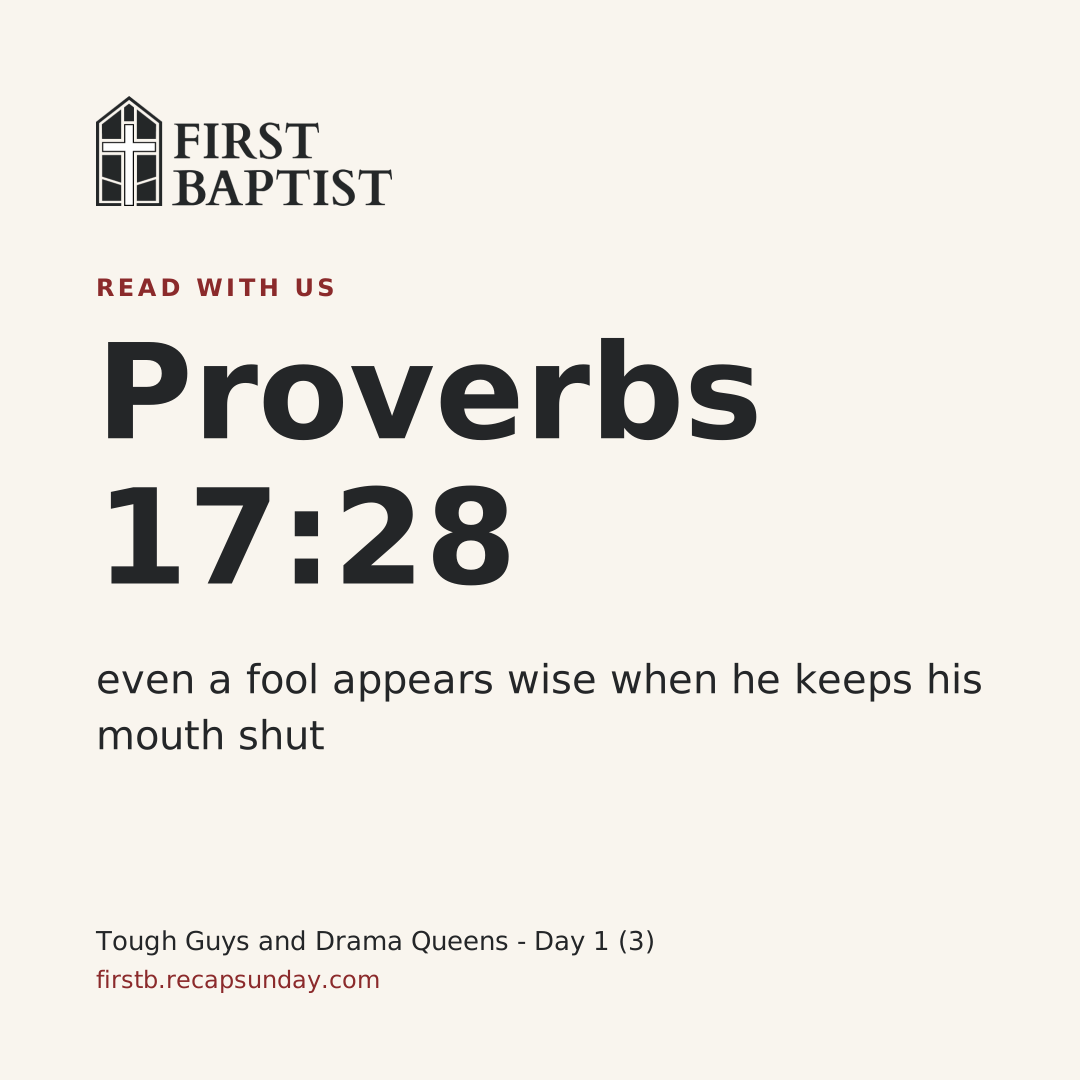
Even if right now, even a fool appears wise when he keeps his mouth shut. That's what scripture says. But it's but there's a point where you just stop, that you'll be amazed in how kids will come to you when you quit talking all the time. Scripture says that a fool delights in airing his opinion. Sometimes there's a time just to stop, to quit, and to do something different.
37:23
It may be engaging with the child differently. It may be affirming the child. Hey, I just want you to know, I don't want you to be perfect. You just do one thing different and it can change the direction of a family. Okay.
37:35
So so on one side, I I I'm gonna I'm gonna use this and say that that this is let's say this is one year old to 12 years old right here, and this is 13 to 19 right here. Okay? So I'm gonna be going kinda back and forth on this thing. But I think during these stages, what we do is we we spend a lot of time pleasing our kids the first six years of their life. Then we spend the next six years of their life protecting them because they'll kill themselves if if not.
38:03
Am I right? I mean, if, you know, just doing stupid stuff. And then and then they get into middle school and we start providing for them and because it makes kids need to show themselves that way. I mean, my my wife is is buying stuff all the time for my granddaughters. I've got four grandkids.
38:22
One's 14, nine, four and two. And always buying stuff for the older ones because it's kind of what you look like. They want them to fit in. Don't you want your kids to fit in? Anybody here go, no, pretty much okay with my child not fitting in.
38:40
I'd like them to be an outcast. I'd like for them not to belong. I mean, doesn't everybody kinda go, no, I kinda want them to be a part of something? So that's what we start doing when they get in the middle school years because it's a crucial time for them. It's time when when Tinker Bell did do her thing and it and everything kinda changes.
38:59
And so we please and protect and provide. And what we don't do is move to a point where we're preparing them for the next stage of life. And so what happens is we never prepare them for the for the world that they're gonna be living in, but we also do this. We also hold on to those parenting styles that say, okay, this is where it works. This is what it needs to look like.
39:21
And they move in and shift out of concrete thinking into abstract thinking. And we don't make the shift. And they're no longer giving us coffee mugs that say world's greatest dad, world's greatest mom, and t shirts that that affirm us and tell us all those things. They're going, oh, get me out of here because they're not getting what they want so they're frustrated. This is what scripture would talk about that that the fathers don't provoke your child to wrath.
39:50
You know, I mean, there's just something that when we don't give them what they want, you know, and you and and then you're kinda going, what? I'm doing the same thing. I'm wait a minute. I'm doing wait. I'm still giving just as much.
40:03
I'm still helping. I'm just they want something different. Are you following me? They want wisdom. Information would be this.
40:14
Information would be knowing that in in the simplest of terms, information is knowing that a, a tomato is not a fruit. You have tomatoes up here? Wisdom is knowing that you don't put a tomato on a fruit salad. See the difference between the two? The tendency of most of our kids have have taken what we think is is wisdom and they look at it as information now.
40:40
Don't have sex before you get married. Anybody want their child to have sex before they get married? Well, I'm pretty much I want them to have sex. No. Nobody says it.
40:50
Everybody's saying, no. I don't want that. And we look at that. We do the purity, thing, and we give them rings and may have them make a commitment. Please don't do that.
41:00
Please don't do that. Cause we wanna make sure you're gonna be pure when you get married, which I have a problem with the concept of that anyway. But there's a there's a part of it where where it's we do that but but but they're looking at his information. What they wanna know is this, the wisdom that comes in that and the wisdom is this, sex before marriage has an amazing way of confusing your relationship. That's the wisdom part of it.
41:24
That's what they wanna hear. They don't wanna hear just don't do it because their culture's changed a little bit. It's this, the scripture would say over and over again that that you would find throughout scripture that that don't have affairs. And and the practical aspect of that, the wisdom, the wise part of that is this, affairs don't end up in a good place. And so it's taking what we know to be true and not putting a spin on it, but putting an application on it so they know, okay, where does this fit?
41:55
I mean, I was Oklahoma Bible Quiz Champ. Thanks to your mother and a couple of this is unbelievable. Her mother was one of my youth leaders when I was in like seventh and eighth grade which is just crazy to believe. Crazy to believe. But I was Oklahoma Bible quiz champ in 1969 and so so so I've always memorized scripture.
42:20
I was y'all probably know me as that. I'm surprised you didn't introduce me that way. Most of you know Mark is the Oklahoma Bible quiz champ in 1969. That that's right. That's right.
42:30
So, the problem isn't knowing the scripture. The problem is taking it and applying it in conversations so that people can embrace what we're talking about and get it so they see the purpose of it because I think a lot of kids just look at scripture anymore. It's more information and that's not what I want and so the difference in between these two things, this is where a child is immature. This is where you wanna bring about maturity over here. Following me?
43:00
This is where you teach. Was that me? This is where you teach. This is where you train. It's different.
43:09
Scripture doesn't say teach up a child in the way it should go. It says train up a child in the way he should go. This is where you give all the answers. This is where you start asking all the questions. This is where you can have more lecture.
43:27
This is where you move to discussion. This is where you tell them everything. This is where you share everything. Are you seeing the difference between the two? This is where you are are spending more time.
43:40
This is about what you do. This is about who you are. This is more about the teaching and information. This is about wisdom. This is about where it's taught.
43:53
The Christian life is taught. This age is where it's what? Is that me? That is you. That I kind of oh, no.
44:06
Oh, I thought that was a knife. I'm going, did I say something wrong? Where's the where's the little other part? Oh, I put it way back. No.
44:15
I might Do you know something that I don't know? I use this thing every Sunday. So Okay. Okay. Now am I on?
44:33
Is that good? Okay. Taught This is where the Christian life is. Caught. Haven't y'all heard that before?
44:52
I grew up with that. Okay, I've coined that phrase now. That's my phrase. The Christian life is more caught than tolerated. You've heard that before in seminary and we all believe that where actions speak louder than words.
45:06
It's not what you say, it's what you do. You know, it's it's trying to think the other phrase that that, don't talk the talk. Walk the walk. And this is what our kids are desperate for because we've eliminated everybody around them that has helped them transition into adulthood. I mean, think about that for a moment.
45:35
Everybody, our kids spend more time in the shallow end of the relationship pool because they, you know, they never go to the deep end. They don't have as many friends as they used to except when they just click on somebody or somebody follows you on Instagram or if you don't have a life, get on Twitter. You know, you can follow us. We shut down our Twitter account. I was always thinking it's a bunch of losers following me.
46:01
Really? You don't have a life that you wanna follow my life. You gotta be really bored out of your mind. You know, I mean, so I'm going. But I mean, I think kids would get so consumed and you find yourself getting consumed in gossip and and and Facebook and finding out about others so you can and I'm going, really?
46:20
Have we really gotten to that kind of world that's more of appearance and performance? You know, and kids are wanting something different and we're missing it because they're wanting the wisdom. They want it to be not taught, they want it to be caught. So moms, when you're always teaching, when you're when you're always correcting when they come home, telling them how they should do it different or telling them what they did wrong, that's about information. That's why they're shutting you down.
46:49
Moms have an amazing way to tell you what I'm gonna tell you, then I'm gonna tell you, I'm gonna tell you what I told you. And if it doesn't work, I'm gonna start over again. And that's what and you know what you're doing? You're pushing your child further and further and further away at a time that they need you the most. Are you following me?
47:09
And this is why I I don't pick on moms, but I think moms play almost a more important role during the adolescent years in this regard. And and it's it's it has something to do with value being instilled in a child's life. I think it's all about moms. Now dads validate it. They're the ones who put the stamp of approval.
47:37
You know, it just there's just something about that. Moms have a tendency to become closer to their sons. Dads have a tendency to become closer to their daughters. That's why scripture says, a man shall leave his mother and a woman leave her home because it's always hard for two women to live together, right? And it's always hard for two grown men to live together.
48:00
You just get to a point where it's like this. Well, and in one sense, if you have a 17, 18 year old son living at home and it gets like this, that's a good sign because it means that your son is becoming independent. That's not a bad thing. That's a good thing. But it's almost that that there's that natural connection that begins to happen.
48:22
I'm all for that. Everybody plays a different role. When Jane and I were in counseling because she was screwed up and and that's my wife. And our counselor told us this, she said, if you guys would just quit trying to change one another, quit trying to change one another, then, you would you would love life more and your kids would love you more. Because my wife was always saying, you're always funny, you're always joking, you're always this and that.
48:54
I'd always be looking at her going, you need to lighten up, back off academics, quit yapping all the time. She would be looking at me going, why don't you get serious? You're the spiritual leader. Are you supposed to be the spiritual leader? I'd be looking at her going, well, I'd try it but if if you'd give me the opportunity, you know, it's like, you ever had those kind of conversations?
49:12
Every husband and wife has those conversations in some way. You know, and and I was at at a a place in California in Westlake Village and I and my prayer on Father's Day, mothers, we have an amazing way of always affirming moms on Mother's Day and bashing the men on Father's Day. Moms, we love you to death. Dads, you're a bunch of scuzz bags. I mean, it's, I mean, we just have the, do y'all feel that?
49:36
Men, do y'all feel that sometimes? No, you don't have to talk about him but I mean, but I mean, it's amazing and so my closing prayer and it just kinda came to me at the end of this service. I said, my prayer for every man in this room is that they'd quit being the father their wife wants them to be and be the dad that God has called them to be. That there's a difference between the two and we try to change those things. We try to change and I'm going, I love the difference and here's the difference between my wife and I.
50:04
I mean, she was bright. I wasn't. I wasn't even in the top 85% of my high school class. She was in the top, you know, like half of a 1%. I mean, she just knocked it out of the park.
50:15
I mean, you know, and so we're different in those things. I like to live life and have fun and laugh in the process. She's a little bit more serious. And you know what? It's balanced out really well.
50:28
Instead of me trying to change her, her trying to change me. So I'm not saying change that. I'm just going maybe bridle it a little bit and realize the impact it's having on our kids not because it's ineffective. It's because they want something more from you that becomes important. You follow me?
50:47
Okay. Now, we're gonna do the slides. Should we do the slides you want? Oh, let's do this. There's cookies here.
50:53
Let's take a break for five minutes. Can we do that? And grab something to eat, grab some coffee. The it it goes fast. We're gonna be finished here in forty five minutes.
51:00
It'll be like that before you know it. So, let's take a quick break. And so, We'll go quick here. Did any of y'all watch the country music awards the other night? Okay.
51:16
Like when Justin Timberlake and Chris Stapleton got up and sang. They just knocked it out of the park. Anyway, it was kinda cool. I take my I take my granddaughter to that. I started six years ago taking her.
51:31
I've been a member of the Country Music Association for a number of years and and which is another story but but and so we get to go and and do the things and stuff II when she was nine years old, we snuck into, we didn't sneak into. We were invited to go to the Warner Brothers They have after parties and but yet they don't let people younger in and so here I am with a nine year old granddaughter and so a group of us couple artists and stuff snuck her in and we were sneaking her in. Kid Rock looked at her and said, oh, the little people are here and and so she's been involved with that whole country thing and and and I will continue to be involved with country music as long as she loves it because it's a way to connect with her and so we connect all the time. And I I would tell you find a connection somewhere and milk it for all it's worth. Give your kids cell phones and allow them to text when they're nine years old and start early.
52:35
I have conversations with my grandkids that is unbelievable. We get on a group text within our family and say things that I are able to laugh and joke. It it's one of the best ways to communicate. Those of you who are sitting there going, no, no, we're gonna wait till 14. You're missing out because your kids are gonna connect some way and we'll talk about that.
52:55
They're gonna connect some way. So, it's a healthy way that you can teach them how to connect with each other. Don't you all just love that comment? Most people don't And, but anyway, a couple of things. I want you to do a couple of things that you can sign up for a newsletter.
53:09
I'm all about getting wisdom into your hands. We send out a couple of articles a week. There's just a thing that went out today that is a, it's kind of a test. We developed a test for parenting where you can figure out what kind of what kind of parent you are and and then it kinda gives you a a whole litany of of things. I spent the summer writing this thing about what you can do to change the type of parent.
53:32
So, I'm I make fun of of of people. It's it's kinda like enabler Ernie or you know, loud mouth Mary or or you know, I just I use the the descriptions but really people go through and they and they kinda get it. But you can sign up and get it there. You can go on our Facebook page and pick it up as well. But my point is wanting to get information to you.
53:55
I'm convinced of this, that there's a lot of things people are given that could be given direction on that will maybe steer something different. Can I use the the can I use the the cell phone thing a little bit? Do you all believe in giving your kids cell phones at nine years old? Most don't. Most don't.
54:15
But your kids are gonna connect because they're made God created them to be relational. God has created your kids to be relational. Now do I like the idea of that? Absolutely not. Okay.
54:28
Are you following me? I I don't. I I don't think I really don't think anybody needs a cell phone. I'm not I'm not so sure that we need bottled water either. We always walk around bottled water like we've been dehydrated for the last three thousand years but lord knows we have to be drinking water, you know, and that or that we even pay for a bottle of water is amazing to me.
54:50
It's tap water. And then it's tap water, you know, and and but it's but it's interesting. Your child is going to connect. Would you agree with me? They long to connect with other people.
54:58
They spend most of their time in the in the shallow end of the relationship pool and so they will connect and and in the process of of them just not having the depth of relationship that you and I had growing up. I mean, the American Medical Association has increased the age of adolescence to age 27. The American Journal of Adolescent Psychiatry has increased it to age 26. They don't have the social interaction. About a third of our kids that have lived with us have been homeschooled.
55:27
The problem isn't homeschooling. The problem is isolation. When you don't allow, you know, kids to do this. You know, as iron sharpens iron, so shall one man sharpen the other. I mean, my does anybody know my sister?
55:43
My sister has raised her kids in an isolationist mentality. We call her kids the children of the corn. And, I mean, they are the weirdest. God. You they can't even relate with a donut or a doorknob.
55:58
I mean, they can't they can't. They just They don't even know how to engage. So you take those that don't know how to engage and throw them into a world where now they're longing to engage. They're gonna do stupid stuff to connect with somebody else. Okay?
56:19
I'm not against homeschool. We homeschool all of our kids. Okay? We homeschool all 60 kids that live with us, but they're not dorks. And, I mean, because they have the social interaction.
56:30
Are you following me? It's not negative. I'm not saying negative. I'm just saying there's a component there that you've gotta watch. And so so your kids are gonna connect.
56:39
And if they are going to connect, you wanna connect in healthy ways. Because in the absence of relationships, they do stupid things to connect. And I and we'll talk about that a little bit. But, I mean, they do stupid things to connect in a world that offers them plenty of things that they can do to make those connections with people. And so I'm always coming up with ways.
57:01
I may not agree with that, with the concept of giving a child a cell phone in ninth grade, but I would do it from a herd management standpoint. I don't whether you all have been around animals, but I I manage people. I manage 60 kids that live with us. I manage the staff that live with us. I want them to learn how to engage and there's things that I allow them to do.
57:26
I don't always agree with it but I've gotta give in on some stuff to get them to a point where I want them to go. I wanna win the war so I can lose a few battles in the process. So maybe it's it's like people believe it. We're not gonna have internet at our home till age 16. Really?
57:48
Now think about that for just a minute. When in second grade there, they're now doing everything online, you know, in classes and stuff. I kinda realized the world was changing a little bit. We always like to blow things up in Texas and and build fires and and all that stuff. And and last New Year's Eve, every New Year's Eve, it's our our our Christmas tradition.
58:12
We take all the we take all the Christmas trees that are from all the houses and we pile them up in our front yard and and and then pour 10 gallons of gasoline on it and after we wrap it with about $2,000 worth of fireworks. And then we hand all the kids Roman candles and we step back and we light all of them and they're shooting from here to the street trying to get that thing to light up and when it does, it is unbelievable. I mean, it is just, it is you think a plane has crashed in our front yard. I mean, it is just huge. And, so afterwards, my then five year old granddaughter walks up and goes, hey, papa.
58:57
Can we do some, some sparklers or some, what are they called? Sparklers. Sparklers. Let's just use that and the morning glories or whatever. I said, well, sure and so so we do that and and she goes and and what do kids do when they do sparklers?
59:15
They draw and and what? Their name and and and my granddaughter goes, look, papa, five years old. I can write my name, my username, and my password. And I thought, it's changing whether I like it or not, you know, and so how do I engage? So you may hear some things that you go, I'm not so sure about that but you have to think about it from the perspective.
59:40
It's managing in a culture that is changing for our kids. And I wanna counter that so that I can remain effective and speak to them at the time that they need me the most. That's basically what I'm saying. So I want you to sign up for stuff. One, I want you to get the newsletter just because it's it's not a promo of anything other than it's articles and videos and and it tells you about stuff and it offers you things and it gives you insight into different things.
1:00:06
The questions that you ask are the questions that we answer, either in videos or in sixty second spots or if it's asked by enough people, then what we'll do is make a weekend program out of that thing and then and then bring in a lot of stuff to to really give a good answer to it. We kinda are edgy a little bit. It's kinda surprising that a lot of country I I mean, that a lot of Christian stations carry us. But I think they realize too that we're edgy enough We're speaking to the hearts of people that are with us. So ask the question on here, but also sign up for the newsletter as well.
1:00:41
Give this to Sam or drop it up here to me so that tomorrow we can make sure that we're answering the questions that you're asking on this stuff. Okay? Follow me so far? What's difficult about the culture? Let's go through this real quick.
1:00:56
We're gonna take about twenty five minutes on this thing and then I'm just gonna tell you a little quick story. We'll call it quits. Can we do that? Kind of a country music story. One, kids are exposed to everything, and that's and that's not that hard.
1:01:08
We've already talked about the information bombardment. And and the point is is that is that is that there's so much information that it that people long for wisdom. They're overexposed to images and words. When you hear your kids start cussing more on online, do you ever see that? Do you all see that with your kids?
1:01:24
Let me ask you, do you cuss more than you did ten years ago? I do. I am exposed to it so much that it comes to my mind all the time. I mean, all the time. I mean, I think I I I really think I just cuss all the time in my head and sometimes out loud when it's just Sam and I or my wife and I or my dog.
1:01:49
My dog has really hurt me and, or if you're with horses, if anybody has horses, you cuss a lot. I mean and it's okay if you have horses. And, but I mean, it's but you just I mean, I think it's because I've been exposed to so much. I've I blush very little anymore. I see pictures of everything.
1:02:07
I just know, okay. Well, click it off. Let's go to the next thing. You know, it's I mean, it's just interesting how you come across stuff, how you don't how watching movies. I mean, my wife and I were watching a a we we were sitting on our we have this big couch in our house watching TV and we're just sitting there talking and stuff and we look up and here's, I didn't know it but it was the Christmas special for Victoria's Secret.
1:02:31
And I'm going, you know what the funny thing is? And we didn't even realize we were watching it. It just kinda came on. I go, if we were watching this thing fifteen years ago, we would have thought it was the most sinful thing in the world. Now, it's kinda, who cares?
1:02:46
You following me? We've all been exposed to stuff. That doesn't mean you eliminate the standard because I still think there is a standard but it's just that I know that I've been exposed to more and so your kids have been exposed and have grown up on that. I know I know when it wasn't and when it is. Your kids don't know the difference, and it comes up with the issues of modesty.
1:03:06
Of course, if you're if it's this cold all the time, you don't have to worry about that. But I mean but I mean, it's but the issue of modesty does come up because where they're coming from and where we're coming from is two different places. And so do I fudge a little bit or do I make sure they wear overalls and cover ups and, you know, I it's almost, okay. What? How far do I go?
1:03:28
Do you all ever deal with those issues? That's all the time. I mean, it's gonna be constant. And just I mean, I hear my daughter in conversations with my 14 year old granddaughter. And I mean, it's just kinda, woah.
1:03:40
Woah. No. You can't show this. You can't do this. You can't do this.
1:03:43
And I'm going, give it a break. It doesn't matter. Kids don't look at it that way. The sex sexualization of a culture, it's evident. It's evident that that it's that it's more sexualized than it ever has been.
1:03:55
The permission for alternatives is there as well. You hear that all the time? I mean, it's interesting to me that I think the marijuana issue is gonna be a huge issue, will continue to be a huge issue. And if it's not for your kids right now, it will be soon. The homosexual debate is amazing to me.
1:04:12
How we respond to that makes all the difference in the world. I think the marijuana I think the Mormon thing became a little bit of an issue a few years ago when we had a guy running for president because of what people have been taught in their comparative theology, you know, and so now we have somebody running. I I think the there's so many different things that our kids are faced with. They're bigger issues than what you and I have the definition of marriage, The transgender thing, you know, where I I'm going, does that I mean, the word Caitlyn. I mean, everybody's changing their child's name from Caitlyn to something else now.
1:04:49
I mean, it's just what it carries with it is interesting. But when you start to look at it how kids look at it, it's different than the way that you and I look at it. Are you following me? And it's just because of how they're being raised in a culture that's more accepting of alternatives than than than maybe when you and I grew up. Are you following me?
1:05:10
I'm not I'm not I'm not saying one or the other. I'm just saying I I want you to have an understanding that the it's the culture that they're growing up in and the influences that aren't controlled by parents. You know, my dad wouldn't let anything in our house that was gonna influence us anyway. And now, you can't control much at all anymore. You know, what you're what you're fearful of, your kids will eventually see.
1:05:35
They'll eventually be exposed to it. And so once they're exposed to it, I wanna start dealing with it, you know, right then. The same girl that came up to me and said, papa, can we do sparklers? Comes back the next year and goes, papa, what's oral sex? I don't know.
1:05:58
Ask your mom. Yeah. I don't know. I'm just going, okay. Where did that come from?
1:06:03
Six. You know, six. You know, and then I was picking up my other granddaughter when she was in the third grade, fourth grade. And this little punk kid runs up and goes, Miley, I'm gonna have sex with you. You know, you just kinda go, are you serious?
1:06:26
You know, I just wanted to grab the come here, you little you know, I I was cussing in my head then. But I sat there and I thought, okay, where does that? How does that fit in as a parent? Because our kids are being exposed to things. You watch Disney?
1:06:43
When you have grandkids, you will. Anybody here work for Disney? The most sarcastic, most sarcastic junk in there. It's amazing to me where every man is made out to be a complete buffoon. And I'm sitting there going, why don't we this is more damaging, I think, than watching other stuff that's more risque and nude.
1:07:08
I mean, this is this is this is just countered everything I believe about the way we engage. And so kids are more critical now than they ever have been because everybody's voicing their opinion, everybody's saying whatever they want, they're encouraged to do so. There's a lack of real connection. Expression is welcome and courage, as I said. It's an appearance an appearance is priority, and performance is crucial.
1:07:36
This is where you see a high school girl's Facebook page, and it's all about this. Will someone just please look at me? Would just somebody please pay attention? And it's will somebody value me? And there's a part of it where I go, get that because I think a lot of us do that.
1:07:55
We we wanna be known and valued in some way. So, we tell people things. Even spiritually, we do that. We quote spiritual things not because we wanna encourage somebody else. We want somebody to think that we're more spiritual than they are because it's it's more appearance minded because it's not relational as it used to be.
1:08:13
People used to be, they're so mobile especially in a community like this. Do you find that? It's pretty mobile community. I lived in Branson, Missouri. We had like a bazillion people just like you guys.
1:08:23
You're billions that end up here. I mean, they would always be coming in, going out, coming in, going out. So the depth of relationship changed a little bit. They're creating a longing for belonging is what it's doing to our kids because they're not having that close personal relationship. They're spending ten hours a day on average looking at a screen rather than eyeball to eyeball with somebody else.
1:08:47
And it's just affecting the way that they deal with that they deal with with engagement in relationships. It's changed. Over responsible parents creates irresponsible kids. We do too much for our kids. We do way too much for them.
1:09:05
We all do. Every one of us in this room has done more than is needed. And you just need to know that we're part of the problem. I I know this and and we won't come up with all the answers. Excuse me.
1:09:19
But I know in the story of the prodigal son, have you all heard that? Do all read scripture here? Okay. Just check it. It's a good book.
1:09:28
And the story of the prodigal is an old it's really an old Jewish story that's been around for a buttload of year buttloads an old Hebrew term. That's been that was there, but but it's been around forever. But the the story that the son said, I'm taking what's mine. And he took a third of the he took his inheritance, a third of what the dad had and left. And and he spent it frivolously.
1:09:54
You know, a prodigal does not mean a runaway. Prodigal means that you spend frivolously. You know, like my wife, she's a she is a prodigal. She loves me going out of town because she just sits and orders stuff like crazy. And I I mean, she just it's just constant.
1:10:10
And, like, all the time. And, I mean, all the time. And, so she's kind of the prodigal. And it was and it's interesting that we all know the story and we hear about that when he came to his senses, when the young man came to his senses, remember that? It says, and he came to his senses.
1:10:28
What are the six words right before that? And everyone quit giving him everything. That problem's been around a long time. Like the homosexual problem. It's been around a long time.
1:10:44
It's mentioned in scripture everywhere. I was at Pompeii in Italy this summer. My wife and I both turned 60 and we've been married forty years this year. So we saved for a trip and we finally took the trip and here we are at Pompeii. Have any of been to Pompeii?
1:11:00
And you go around Pompeii and there's pictures of the homosexual. There's fret with frescas. Is that what they call them? Up up on the walls and you're going, they did it back then. It's been around a long time.
1:11:15
The kids cutting self harm. It's mentioned in scripture that there was the it was the the mental guy, the demon possessed man cutting himself in the graveyard. It's been around a long time. We get we think that it's new. There's really nothing new.
1:11:31
Tattoos, they've been around a long time. I mean, it's not like anything. My dad even has a tattoo. When he got it, it was here and and, he turns 90 in a couple of weeks and now his tattoo's down here somewhere and, so it's different. But anyway, the over responsible parents, we just do too much sometimes.
1:11:50
And what that does, it stifles motivation, it eliminates creativity, it promotes irresponsibility. I mean, what it does to our kids is just eliminate some things. And the and the challenge isn't, please don't hear me saying quit giving them don't call them tonight. I'm cutting you off. Don't that's not the way to do it.
1:12:06
But it's knowing that us doing that because every one of us in this room lives in the top 1% in this in this world. It's just the nature of of our society. So it's more, okay, if I know that that's happening, what can I do different to counter the issues that that causes when we have a group of kids moving in that direction? It postpones maturity as I mentioned earlier. The next thing is no one gets respect.
1:12:34
Personal agendas have replaced the concern for others. And I and I say this, you know, what's the first word that comes to your mind when you think of the word priest? What's the first word that comes to your mind when you think of the word coach? Teacher when Ferguson, Missouri. What do you think of?
1:12:53
You would almost think that there's so much stuff out there that that everything's a complete mess. When in actuality, it's not. Crime is twenty five percent of what it was in 1980. The abortion rate has continued to go down since 1979. It's been on a steady decline.
1:13:12
Teen pregnancies are at an all time low right now. Isn't that amazing? You wouldn't think that, would you? You know, the the chances of of your child being kidnapped are so far less than they were twenty years ago. It's amazing.
1:13:27
Because we hear about everything. And you think tornadoes are just ramping. Right? Do you know the last time there was a rash of tornadoes in in this country? I mean, a real rash.
1:13:40
1974, when we lost our home in a tornado. Just just look it up, numbers of tornadoes. It's amazing. You would think that everybody's getting eaten by a shark, you know, not Wyoming. But but yeah, sharks don't live in cold water like this.
1:13:58
But but, I mean, you don't you think that because you hear so much information about that. But you know the number of people that actually been that actually die from a shark attack in The US a year? Less than one. But you think that it's big. And my point is whatever they pay attention to and listen to, that that's what they really believe.
1:14:20
So they really do believe that all teachers are that way or all pastors are that way or all when they get into their mind, something's wrong, that all policemen are that way. The way that policemen are being treated is horrible. It's horrible. There may be a couple of bad eggs, a couple compared, but they're being treated awful. I mean, the way that people look at their same way that we treated same way that we treated really the military back in the fifties.
1:14:48
I mean, just you you kinda see that happening. And and my my point is is that is is that the the way that they've been exposed is creating this world where they think it's worse than it actually is when it's really a lot better than what it was. And as a result, because because nobody respects anybody, that respect is no longer given, but it's gotta be earned. I a a new kid comes to Heartlight. They come in the front door, and I have gotta tell you, I have been cussed out, yelled, and screamed at, told to go f myself and do things that I didn't know were humanly possible.
1:15:23
You know? And I just go, doesn't matter. I mean, they because it's there's not the immediate respect anymore. Kids don't give it, and they don't give it because they haven't learned it that way. Then they may have from you, but they haven't learned it from other places because the world is telling them differently where they're getting all the information from.
1:15:44
Follow me? There's a loss of gender differences. And I don't wanna spend a whole lot of time on that, but I just think boys are confused what it is to be a man. And young ladies are are are misled to believe what it is to be a woman. I I I think it's just that simple.
1:15:59
It's by what you watch. I think about what I watched in my concept of a man. I used to watch old westerns. Can you tell? Probably why I sport a mustache the way that I do.
1:16:09
I got a letter two or three weeks ago. It said, dear Mark, please send us back our mustache. Signed 1880. You know? And and so I know it's outdated, but we we fit I mean, you look like colonel Sanders.
1:16:22
You you you and I, I could be Sam Elliott, you'd be colonel Sanders, and we can sell chicken at rifle point. You know mean? Or something. We could do it, man. I love it.
1:16:32
And but I go I I I know what I watched. I watched every western show there was where the good guy wins and you treat a lady like they're supposed to be treated and you honor people, you do what's right, and you take all your all you can stand till you can't stand this no more. I mean, but we were taught by the things that we watched and now I think about what kids watch and it's kinda concerning. Really? That's your concept of what it is to be a man?
1:16:57
That's your concept of what it is to be a woman? And I just think it's confusing for them. And so I think that's where it's been it it's good to spend some time having those discussions. A man made a comment to me. He said, I need to go home and have a discussion with my son.
1:17:11
When this thing about Caitlin came out, I need to go ahead and have a and have a discussion with my three sons this afternoon and kinda straighten them out on that. I said, dude, let me tell you something. It's gonna be a long discussion over the next few years until you straighten this one out. I mean, this is just I mean, I think what we're hearing and what kids are seeing, it's not gonna be a one time shot. You need to believe this.
1:17:34
This is true. This is it. Boom. It's gonna be a discussion that's gonna be happening the rest of your life with your kiddos in looking at some of the stuff going on. They live with constant uncertainty.
1:17:47
Everything changes. People move. Possessions get dated. I mean, your phone that you have is already outdated. Do you know that?
1:17:54
You're going, yeah, it is, isn't it? But do you still have an old flip phone or bag phone or something? I see. Oh, it's a good one. Yeah.
1:18:00
I mean, but it's amazing how you loved it at one time, right? I hate this phone. Do you? Yes. I mean, when you got it, did you hate it?
1:18:08
Yes. Yeah. Oh, wow. Well, you're different than everybody else I've talked to. No, but I mean, it it is.
1:18:13
It's dated. Like, what is that? An iPhone one? No, iPhone five s. Well, that's what I have.
1:18:21
And I said the same thing. I was telling Sam, God, I hate this phone. I don't know why it doesn't work. You know, so I'm hoping somebody steps on it or anything. I'll throw yours against the wall if you can throw mine against the wall.
1:18:32
Okay? Okay. Well, then it won't matter then. Here, give it to me. No.
1:18:36
No. Never. I'm gonna do that. But my point is is that everything gets dated. Everything changes.
1:18:41
Everything's always mobile like this. I mean, it's just amazing and and you kinda look at it and you go, think about that for a minute. Nothing remains the same anymore. So if that's true, then what it does is kinda turn me inward as a kid and ambivalence enters. Ambivalence is getting to point you just don't know which way to go.
1:19:02
I'm kinda ambivalent. Yeah. I get to a fork in the road and go, I don't know. I'm convinced of this, is that kids will follow wherever the relationship is because they're created to be relational. Wherever that relationship is, I don't care how negative it is, how anti valued and principled it is, they will follow the relationship because that's what they long for.
1:19:27
And so the next I'm just gonna spend a few minutes on the next part. The next part is is more okay. It's a culture that that's all the things that I just said it was. Let's go through this. Okay.
1:19:40
It's all those things. Okay. And buy that book. And if and buy those too. And if you can't afford the books, we'll give them to you as a gift from me.
1:19:48
But the second part of this is why traditional parenting doesn't work. I and I can hit on three things because we'll talk about it a little bit more tomorrow. But I've never heard a mom say this in in this part of it. I've never heard a mom say that I want my daughter to be a perfect child. Have you ever heard that?
1:20:08
I've never heard a mom say that. Never. I've never heard a dad say, you know what? I wanna rule my home with an iron fist. I wanna tip.
1:20:18
You know what that means? Like this? You know, I'm gonna rule this. For me and my house, we will serve the Lord and this is what it's gonna look like, you know, and I've never heard a man say, I wanna rule. I wanna be an authoritarian in my home.
1:20:32
I wanna rule strong like that and I've never met parents yet that have said this, we wanna be judgmental parents. Never. Y'all ever said that? I've heard hundreds of girls say this, my mom wants me to be perfect. I've heard hundreds of young men say this, my dad rules with an iron fist.
1:20:58
I can't wait to get out from here. I have heard thousands of kids say this, thousands. My parents are the most judgmental people I know. And I would tell you, the traditional parenting of perfection where it's authoritative and more military, where it is judgmental in comments, it doesn't work anymore. And so when you just get the impact of that, it'd be easier.
1:21:28
I mean, I've lived with 3,000 kids. It'd be easier when it was more military. It was easier because we can control everything. But then I just found out kids aren't responding. We used to whack kids.
1:21:41
I mean, not shoot them, but I mean, I wanted to. But, you know, but we used to I mean, we used to have a paddle and just whack them. Well, Mark, how hard you gonna hit me? As hard as I want, you know, as hard as I can, you know, and we used to bend them over and whack em and we videotape and then we'd laugh at it later. Remember those big old video cameras, where you're going like this, but we'd videotape while we're doing it really for protection of us.
1:22:10
But this was like twenty five years ago and I go, it made it easier but you can't do that now. There's so many things you can't do. So you appeal to something different. You know what you appeal to? The relationship.
1:22:24
If you have a discipline problem at home, you have a relationship problem. If you have a discipline problem, you have a relationship problem. So we'll talk about that tomorrow as we kinda kick things off. But my point of it is is saying it's the this perfection thing. You know, kids think that we want them to be per perfect because they live in appearance and performance world.
1:22:50
They think that we're gonna rule like this because they're pushing back against that everywhere else. And so when we try to do that, it's just no longer effective. The world isn't creating our kids to respond to that. It works when you're trying to teach them. It doesn't work when you're trying to train them.
1:23:06
Is anybody here in the marines? I was at Camp Pendleton and spoke to a group of, drill sergeants. That was different. And, I mean, you try to crack a joke and they just didn't laugh. And, so I had to cuss a little bit to get them to follow me.
1:23:23
Then they thought, okay, this guy's good. But this colonel who had a son live with me, he asked me to come out and speak to me. But I spoke on the whole concept of the relationship. And and and this was a purely financial deal for them. They've invested so much money in people.
1:23:39
It cost $12,000 to recruit recruit one person to enter the marines. Did you know that? It's 10,000 for the army. It's like 14,000 for the navy. But $12,000 to get somebody to serve in the marines.
1:23:50
By the time they sign on the paper, that's how much they've spent to get them to that point. And so now they go through basic training. Now they've spent so much money that now they've had a $100,000 invested in this kid. And when they are going like this sometimes, those kids are going, screw you guys, I'm out of here. And they're losing kids because they'll say you can't get out.
1:24:11
Well, it used to be that you couldn't get out. Well, now you can and you can sue them if you want. And so my comment was you gotta appeal to the relationship side, not just always the military, you know, and and the militaristic side on that. And so my point is is that sometimes it doesn't work. Sometimes the the perfection thing doesn't work.
1:24:31
So I always flavor the way that I engage with kids. Hey. Hey. Hey. Hey.
1:24:34
Hey. I want you to know something. I don't want you to be perfect. Matter of fact, matter of fact, I think all of you guys, when I made a comment about my wife and I going through counseling, there was probably more of an attraction to that to me than it was that I wrote books. When I tell you that that I wrote that I was raised in a dysfunctional family that my sister's kinda weird, you everybody identified with that.
1:24:56
You know, you go, I don't know. We all got a weird sister somewhere, you know, and my brother's an atheist and I, you know, and and I mean, it or my wife was sexually abused for seven years from ages five to 12. That's the connection that people make. When we start sharing our imperfections, that's where you go, I like this guy. It's not all the other stuff that we think that's perfect.
1:25:18
So when you move from this area here where kids look at you as being perfect, you want them to start looking at you here as being imperfect because you connect with them. You guys can't stand to be with a perfect person, can you? No. You can't. You hate it.
1:25:37
It's miserable. And they hate being with you just as much as you hate being with them. You know, if you think you're perfect. So when you start sharing your imperfections, that's when you share it with a child. And you're waiting for that time to happen.
1:25:52
And we'll talk about that a little bit more tomorrow. Okay. We're gonna end on this, a little country music deal. I was in Chicago and we were preparing to do to get on Moody Radio. Moody Radio is a is a very strict conservative radio station.
1:26:11
Do y'all have Moody here? Yes. Oh, darn. And Yeah. Yeah.
1:26:18
Yeah. And when I'm I'm we record all our programs at Moody and so it worked out really well but they were testing us out. Nobody at Moody looks like I do. I mean, nobody has a mustache. Nobody, you know, nobody wears boots and nobody, I mean, I don't I I I don't think any of those guys walk out of their home without their cuticles pushed back every morning.
1:26:40
I mean, it's just a diff, it's just a, it's just a different group and do you push? No, don't. He looked at he went, oh, look at this. Yeah, yeah. And so, so, so anyway, they they ask if we would come and and do a morning show.
1:26:57
They're going to test us out because we were asking to carry our program and and they said, would you come? And so this was on a Tuesday and we're going to come to this this deal and and and and just kind of let them show who we are and they said, what you'll do is talk for an hour and we'll ask you questions and stuff and then the next hour, the time you're talking to a million people, let people call in and ask questions And I said, well, that'll work out well. And and so so we just thought it'd work out good. And they had all their people there. I mean, the from the president to the of of the radio deal to program directors to everything and and our producer was there as well.
1:27:39
And and you have to understand that Moody is a pretty conservative. It it's very conservative. If they had a sound that would describe Moody, it would be like that. And, and they're just like that. And, so here I come in.
1:28:00
And so I said, well, we'll do this. So we got there. Well, what you have to understand, this is on a Tuesday morning. The day beforehand, they had just come out with a report that this one man named Ted Somebody who used to be the president of the National Association of Evangelicals and used to be a pastor of a church in Colorado Springs who was an anti anti anti anti homosexual preacher and then going to Denver and having a homosexual relationship but anti anti anti then going and having the relationship and then anti anti anti. Then have it.
1:28:33
Well, that guy up there that he was having a relationship with finally spoke up and said, this is what he's doing. So they would did everything but crucify him. They hung him out to dry, kicked him out of the church, you know, all this stuff on and on. Okay. Well, this guy this guy, Ted had gone through counseling.
1:28:48
He had reconciled his relationship with his with his family. He had restored his relationship with his wife. He got back on track. I mean, everything just he just went through the process of of restoration, I think. And so on the Monday before I was supposed to speak on Tuesday, it came out through SRN Radio through the second page of the Wall Street Journal, fourth page of USA Today that Ted, what's his name, was a 100% heterosexual.
1:29:18
Do you all remember that? When it came up, they just said he's 100% heterosexual and it was everywhere. 100% heterosexual. 100% heterosexual. 100% heterosexual.
1:29:29
And so we get through the first hour of us talking and now it's time to take questions and some lady calls and says, hey, Mark, I've got a question for you and I said, well, go ahead sweetheart. What is it? She goes, are you 100% heterosexual? And everybody in the room just kinda went like this. And it's almost like the birds quit flying outside.
1:29:54
You know, it's it's everything just kinda stopped and I said, you know, I don't think so. I mean, the plane stopped in the air. Cars quit in Downtown Chicago. I mean, we're talking to a million people and now when I said, I don't think so. I mean, eyes just went like this.
1:30:12
Everything got quiet. Everybody leaned forward. Our producer was sitting there going, oh no. Oh no. I knew this was gonna happen.
1:30:19
I knew this was gonna happen. And I said, yeah, I don't think so. I think I'm 95% heterosexual. I think I'm 3% metrosexual because I wear Tommy Bahama shirts occasionally, and I'm 2% homosexual because I'd kiss Keith Urban if I had the opportunity to. And I thought it was funny.
1:30:40
I just go I was going, man, Mark, you are so good. In my head, I was going, ah. You know, I thought, I just knocked it out of the park. I thought it was unbelievable. I just thought it was unbelievable.
1:30:55
I go, how did I come up with that so fast? And the next thing you heard was, and the weather in Chicago is and they cut from me to the weather and I sat there and so I heard this, Mark, Mark, you can't say stuff like that. You can't say stuff like that. They kept knocking and knocking and everybody in our our our producers going, oh no. Yeah, they're gonna cut.
1:31:21
They're gonna get rid of him now. They're gonna get rid of him now. So, it's during the commercial break and I said, guys, you guys gotta lighten up because if you don't lighten up, you'll never have the opportunity to talk about the hard stuff with kids or parents. You gotta lighten up. I was in Duck Dynasty Land.
1:31:45
I guess it was a year ago And, this guy comes up to me afterwards and he and he well, this one lady came up. She's like a 130 years old. It came up and said, Mark, we haven't we haven't laughed like that in fifty years, you know, and and, then this man walked up to me and he said, Mark, you can always throw a bigger brick if it's wrapped in humor. You think? We need to lighten up.
1:32:12
We are so serious in a world that demands a little bit of levity sometimes. Yeah. I I think laughter is a is a form of worship. It truly is. I can laugh in the face of danger.
1:32:24
I can be like little Simba on, the lion king in the elephant graveyard, you know, and I can laugh in the danger in the face of danger. It's okay. We're children of the king. We're good people. We're called to be good people.
1:32:38
We're standards. We're we're we're we're the light that that shines in the darkness. We're the salt that adds flavor and yet we're so nobody wants to be around us. When we lighten up, it changes things a little bit. K.
1:32:54
The second part of the story. Two years later, we're in, Leapers Fork. It's five after nine. We'll quit here in just a minute. We're in Leapers Fork right outside of Franklin, Tennessee.
1:33:06
And, we're in a little tiny sandwich shop. We're recording at Michael Card's studio. Michael Card wrote a song years ago called El Shaddai. And, and so we're at his studio. We take a break, and we're all eating lunch at this sandwich shop.
1:33:22
And, just the four of us just sitting around little little tiny tiny place. Well, guess who walks in the door? Keith Urban. No. And so one of our guys goes, well, Mark, there you go.
1:33:35
You know, and and so so I walk up to Keith and and Nicole and and she just kinda like that and for like an hour and and so I hold up my hand, Keith. I'm Mark Gregson. I said that I was 95% and I said I was 32% that I'd kiss you if if I had the opportunity and he just looked at me and goes, well, that ain't gonna happen. He didn't think it was funny either. You know, so, anyway, that's it.
1:34:10
That that's my country music deal of the day. We're gonna be spending time tomorrow looking at the model of saying, okay, if these things are true, then how do we do it differently? How do we engage differently? I'm serious about leaving some questions. I'm I'm would push you to spend some time, really spend some time, then sign up for the newsletter.
1:34:30
You need to get on tonight and find it. Just Google any of us. I mean, Google my name or parenting today's teens or hardly. You'll find our stuff online. Go to the books, purchase them if you need them.
1:34:43
If you can't afford them, then it it's a gift from me to you because I want you to have information to do that. Anyway, it's been wonderful tonight. We'll see you guys in the morning at 06:00. Is that right? No.
1:34:52
That's okay. No. What time are we are we going on in the morning? At 09:00. See you then.