0:00
Speaker 2We just pray your shalom. You're resting upon Becca as she ministers your word. Oh, might you breathe on it and might it be life and encouraging to us, strengthening to us as we walk this amazing walk as your children. It's in your holy mighty name, Yeshua, that we pray. Amen.
0:31
Speaker 1Hi. Good morning. So I get really nervous, but I am so thankful because I have so much support. And when I look out, I see all of you. I'm like, these are all my friends.
0:42
I don't need to be nervous. This is such a big chapter and I'm so excited about the truths that are in it. I'm so thankful for the support I have. So Deborah's always calling and... Or texting and checking in.
0:58
How are you doing? You know, and she's so encouraging to me. And this past week, she texted to check-in, I said, any insight is welcome. And she wrote back, she said, Abba is a faithful father who never gives up on us. And even though Israel is not really interested in his right way, Jesus, Abba's eye is still on them, and someday he will draw them into him and set up his kingdom in Jerusalem.
1:23
He is very patient God, and his faithfulness is something we can't imagine. His compassions never fail. I just thought that really summed it up, this chapter, so that's where we're going. I felt like, and I kept saying to some of my friends, I was talking to Emily the other day, and I was saying, just don't feel like there's much application because it's about Israel. This chapter is about has God rejected his people?
1:46
And we're talking about ethnic Israel. And so I was just thinking this is just the word, and this is just... We're just gonna learn, and there's not much application. But I feel like Romans 11 is a chapter that shows who God is and like his work throughout history. And we see the way that God has acted from the beginning and the way he's acted toward Israel and nations in history, and it's all about God and who he's like, what he's like.
2:17
John Piper said, This is why history matters, to reveal God. God doesn't exist to unfold history. He is the first and the last and middle. It's all about Him from the beginning to the end. The universe exists to display the fullness of the glory of God's perfections.
2:38
I love that. Then at the end of the chapter in the book, Weirsby, he says, After all we've learned about this, he says, Having contemplated God's great plan of salvation for Jews and Gentiles, all Paul could do was sing a hymn of praise. He said, Theology becomes doxology. And I think that's our application. When we see God and who he is and what he's done and his plan, our response is worship.
3:10
That's what I'm praying that we just see and then we stand in awe of who he is as we see his plan unroll and just unroll and that our response is worship. Okay. So I'm gonna pray. Lord, thank you so much for your word. Lord, we thank you for your power, and we thank you for your Holy Spirit, Lord.
3:34
And I just pray, Lord, I just want to be your vessel. I want speak your truth. Just speak through me, use me, speak to me. I wanna learn more. I wanna learn from you, Lord, and we just pray that our hearts would be wide open, and we could hear the message that you have for us this morning.
3:52
It's in your name we pray. Amen. Okay. So first, before we get into Romans 11, I just wanna have a quick word about covenant, and I talked to you about the support that I have. I also have the support of my mom who's a Bible teacher.
4:06
She's like, I really think you need to talk about covenant, She gives me all these notes and we talked till midnight last night about covenant. This is all coming from that. I believe that understanding covenant is gonna make Romans richer and hopefully helping us understand the last couple chapters even more. So this is just like a quick overview of covenant and just knowing that God is a covenant keeping God and how important that is. It's really cool because it starts at the very beginning in Genesis.
4:46
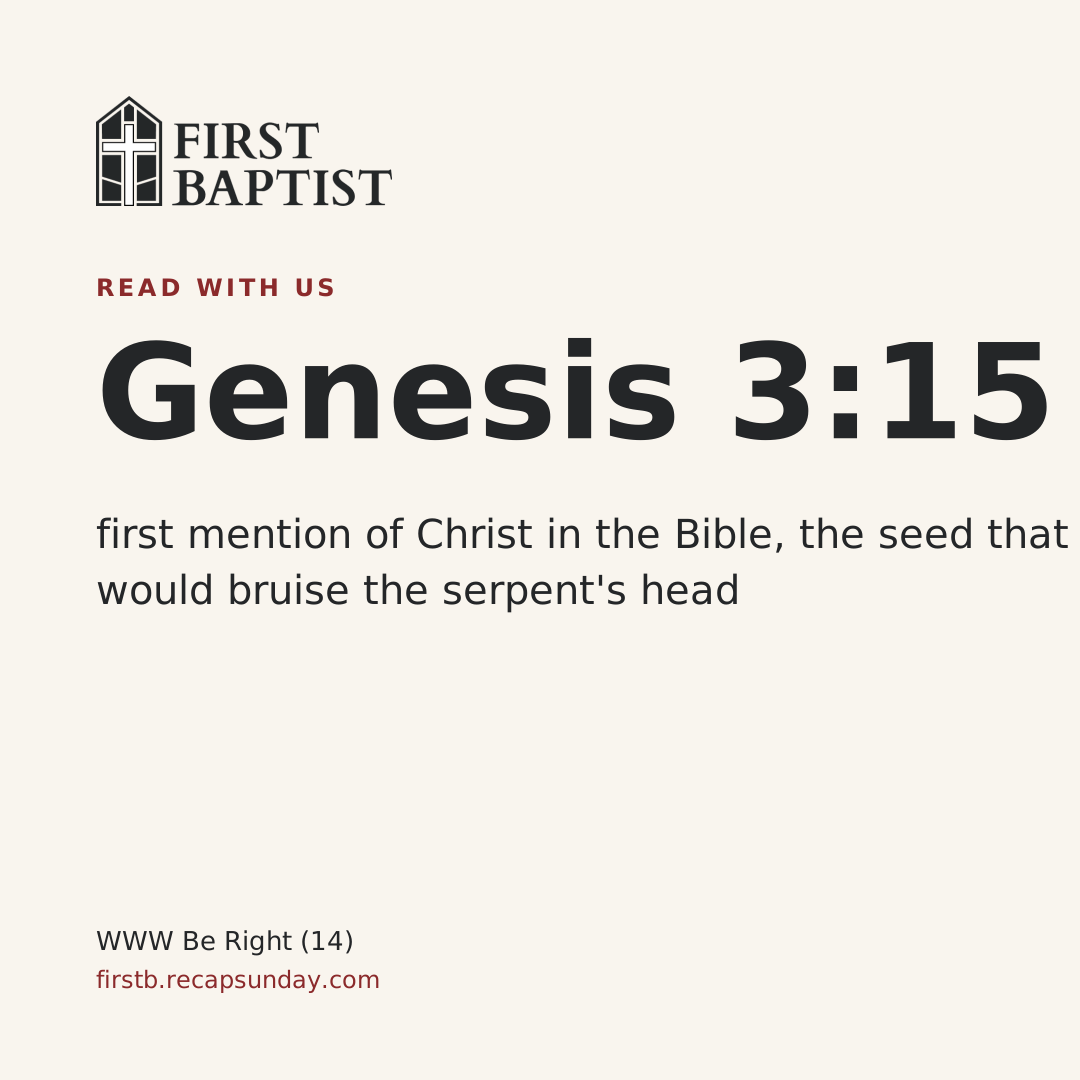
Genesis three, when Adam and Eve sinned, God already had His plan and He already starts to talk about His plan for salvation. Genesis three fifteen is the first time that Christ is mentioned in the Bible and God is talking to the serpent and He says, And I will put enmity between you and the woman and between your seed and her seed. He shall bruise you on the head and you shall bruise him on the heel. So it's talking about this seed that will become from a woman and the seed is Christ. It says, He shall bruise you on the head, so that's a death blow to Satan.
5:31
Then it says, You shall bruise him on the heel, and that's a picture of crucifixion. From the very beginning, we see that we have a promise and that God already has a plan for our salvation right after that first sin. Covenant. Covenant is a word that's all throughout Scripture and there are three important covenants that are part of our salvation. I love God had promised Abram land and descendants and promised, I'll be your God, you'll be my people.
6:06
In Romans 15, God... Abraham starts... Abram starts to question God, how will I... Who's going to be my heir? I don't have an heir except for this servant that's living in my house.
6:21
God says, No, your heir is going to come from your body. In verse five, God promises descendants and that's when we see Abram say, Believe God. Then he believed the Lord and he reckoned it to him as righteousness. We've talked about that a lot, so righteousness comes through faith even from the beginning. Then we see God promising...
6:55
He's promising descendants and land and Abram... Right after that, I think it's kind of interesting. He says, Well, how can I know? He's already just like, God, show me. How can I know?
7:06
God says, Bring me the animals. And what's cool about this is Abram knew exactly what to do with these animals. He knew that God was saying, We're gonna make a contract. It's time to draw up a contract. And in that day, contracts were made by cutting and sacrificing animals.
7:27
They would cut the animals and they would split the carcasses into two pieces lying on the ground, and then the parties of the covenant would walk between the pieces of the animals repeating the terms of the covenant. So literally in Genesis fifteen eighteen, it says, the Lord made a covenant. It's literally the Lord cut a covenant. So the important part about that is there's the symbolism. First of all, covenant involves blood.
8:00
It's sealed with blood and then the symbolism of this walking through the pieces is it's saying, let this happen to me. What happened to the animals? Let this happen to me if I don't keep this covenant. The coolest part about this is it says that God had Abram fall into a deep sleep, and so this covenant was one-sided. God was the only one that walked through the pieces.
8:34
This was a promise made by God to these people, to Abram. He made this covenant, and he's essentially saying, I'm going to keep it or else this is going to happen to me, and this is God. So we know that God... That this was an important promise to these people. Okay.
8:56
The other really cool part about it is that God in verse five promised this... It says in my Bible, it says descendants, but if you look at the Hebrew word, it says seed, and it's a singular word for seed. And Galatians three sixteen says, Now promises were spoken to Abraham and to his seed, and he does not say and to seeds referring to many, but rather to one and to your seed that is Christ. So there again, we see God promising this seed, that is Christ, and that's when Abraham said, I believe you, and it was reckoned to him as righteousness. So he was believing in this seed of the Messiah that would come, and that's why that was his faith and that promise that God made.
9:55
Okay, so now they know that the Savior is going to come through a woman and now we see that it's coming through Abraham's seed. And so we say it's by faith and we've talked about it was not through circumcision and doing all these other things because circumcision came later and it was a sign of the covenant. It's interesting that circumcision happens at the place of the seed in the loins because it was just a reminder that the Messiah would come through their loins. The next important covenant was the law. When the law was given at Sinai with Moses in Exodus 24, they entered into a covenant with God.
10:48
When they made the sacrifices, half the blood was sprinkled on the people and half the blood was on the altar. So again, we see sacrifice and we see blood, and we see the people are responsible for keeping the law. Israel entered into that covenant and they said, Yes, we will do all that you say, O Lord, we will obey. And they kept the law, they were trying to keep the law through their own efforts in their flesh. In Romans three, Romans tells us why the law or the old covenant was given.
11:22
So Romans three nineteen and twenty, it says, Now we know that whatever the law says, it speaks to those who are under the law that every mouth may be closed and all the world accountable to God because by the works of the law, no flesh will be justified in his sight. For through the law comes the knowledge of sin. So that's the point of the law. The law was a sign. It wasn't the answer itself.
11:51
It pointed to our need for a savior and our need for that Messiah. Okay, so then there's the New Covenant, and this New Covenant was promised in the Old Testament in Jeremiah. Jeremiah 3one 31 through 33. It says, Behold, days are coming, declares the Lord, when I will make a new covenant with the house of Israel and with the house of Judah, not like the covenant which I made with the fathers in the day I took them by the hand to bring them out of the land of Egypt, my covenant which they broke, although I was a husband to them, declares the Lord. This is the covenant which I will make with the house of Israel after those days, declares the Lord.
12:37
I will put my law within them, and on their heart I will write it, and I will be their God, and they shall be my people. Okay. So this covenant was instituted by Christ at the Last Supper. Matthew 26, twenty six and twenty eight says, And while they were eating, Jesus took some bread and after a blessing, he broke it and gave it to his disciples and said, Take, eat. This is my body.
13:10
And when he had given thanks, he gave it to them saying, Drink from it all of you for this is my blood in the new covenant which is poured out for many for the forgiveness of sins. And of course, this covenant was finalized at His crucifixion and then His resurrection. Matthew 2seven 50 through 51, And Jesus cried out again with a loud voice and yielded up His Spirit, and behold, the veil of the temple was torn in two from the top to the bottom, and the earth shook and the rocks were split. So in the Old Testament, they had the temple and they had the veil that separated the holy of holies where that was the presence of God separated from people. They didn't have access to the Holy of Holies, but when Christ died, the veil was split from top to bottom.
14:05
It was ripped into two and that was His flesh. In Hebrews ten nineteen through 20, it says, Since therefore, brethren, we have confidence to enter that holy place by the blood of Jesus, by a new and living way, which he inaugurated for us through the veil that is his flesh. So we are entering into a covenant with God as we walk between the pieces of Christ's flesh into the presence of God. So it's... Again, it's the blood spilled.
14:38
It's the two pieces of flesh that we're walking through in a new covenant with the Lord for salvation that comes through faith. Abraham, it was by faith, it's always been by faith, and the law just pointed out our sin and our need for the savior. God keeps his covenant. He promised this seed. He promised these things, and we see these things happening.
15:04
That's where we are today. We're asking, has God rejected his people? The answer is no because he himself walked and he made this covenant and he will not break it. The good news is that we're going to see that Israel is going to respond in a future time and they're going to believe and trust in Christ. So Romans 11.
15:31
Last night when I was doing this I was like, I'm doing so much and then I'm not even in the chapter yet. It's so good and I feel like it just... There's just so much here. So first we're going to start with the very last verse of chapter 10. Chapter 10 ends with, he was quoting Isaiah.
15:58
He says, But as for Israel, he says, All day long I have stretched out my hands to a disobedient and obstinate people. So remember when they said, Oh yes, everything you say we will do. Well, they didn't. They tried to live the law in their flesh but failed. So he's questioning, so they've been disobedient and obstinate.
16:24
And so that's what brings Paul into asking this question. And starting in verse one in chapter 11, I say then God has not rejected His people, has He? And he says, May it never be. And the first proof he says is, For I too am an Israelite, a descendant of Abraham, of the tribe of Benjamin. The first point is God does not reject His people.
16:51
He's covenant keeping, And this is ethnic Israel that we're talking about. And Paul is using that as proof saying, I am I'm an ethnic Israelite. I was a descendant of Abraham, a tribe of Benjamin. Then in verse two it says, God has not rejected His people whom He foreknew. So these are the people who He foreknew.
17:19
In Amos three:two he says, You only have I chosen among all the families of the earth. God has known them. Says, Or do you not know what the scripture says in the passage about Elijah, how he pleads with God against Israel. Lord, they have killed your prophets. They have torn down your altars, and I alone am left, and they are seeking my life.
17:48
But what is the divine response to him? God says, I have kept for myself 7,000 men who have not bowed the knee to Baal. In the same way then, there has also come to be at the present time a remnant according to God's gracious choice. But if it's by grace, it's no longer on the basis of works. Otherwise, grace is no longer grace.
18:16
So point one, God did not reject His people. Two, He foreknows them. Three, He kept a remnant. In the days of Elijah, he thought he was the only one left and he was even praying against his people because they were killing the prophets and tearing down the altars. Things were so bad that Elijah was praying against his people, but God said that he had kept 7,000 men that had not bailed the knee to Baal.
18:49
It says, In this day too, we have a remnant according to God's gracious choice. I think of Christine, she's part of that remnant. I just think it's precious that there are believers that are from ethnic Israel that just... That shows that God's not through with those people. And how are they a remnant?
19:15
It says it's by grace. It's by God's gracious choice. Sounds like how we're saved too. Just thinking about that, remember Jews aren't saved just because they are a Jew ethnically. We're all saved by grace through faith.
19:36
In Romans two:eight-nine, it says, But to those who are selfishly ambitious and do not obey the truth but obey unrighteousness, there's wrath and indignation. There will be tribulation and distress for every soul of man who does evil, of the Jew first and also to the Greek. So we're all in the same... We're all saved the same way. I think about the fact that we all deserve wrath and indignation.
20:12
I think sometimes we think, Well, I kind of deserve a little bit of grace and that's why God chose me or that's why I've been saved. But we don't at all. None of us do. I think that when we realize that, we think about how are we responding to that grace that we are chosen by God's gracious choice. What what does that mean in our lives?
20:41
Are are we praying for the most hard hearted person we know because we know we didn't deserve it and God has saved us from that for a purpose. The gospel is the power of God, so we can trust that if there's someone we know that we love that is the most hard hearted person, God can save that person because the gospel is the power of God. So that's been a thing for me. There is a little bit of application in this chapter. How are we responding to that grace?
21:24
Okay. So in verse seven, it says, what then? What Israel is seeking, it has not obtained. But those who were chosen obtained it, and the rest were hardened. Just as it is written, God gave them a spirit of stupor, eyes to see not, and ears to hear not, down to this very day.
21:49
And David says, let their table become a snare and a trap and a stumbling block and a retribution to them. Let their eyes be darkened to see not and bend their backs forever. And that's heavy, but again, it's talking about Israel. What they were seeking, had obtained not. So as a whole, they don't know the Messiah, but there there's a remnant that were chosen and those are the ones who obtained it and the rest are hardened.
22:26
So I feel like there's two ways to see this table and I love I love both of these, and there's more application. Yay. Weirsby, I loved what he said on page one thirty seven. He says, their spiritual blessings should have led them to Christ, but instead, they became a snare that kept them from Christ. Their very religious practices and observances became substitutes for the real experience of salvation.
23:00
So they were the ones that were chosen by God. They had the covenant with God. They had his blessings. They were his people. They had the law.
23:09
They had everything. But those religious practices were what became the snare because they thought that was the substitute for the real experience of knowing God in faith and in salvation. I feel like that can be an application for us too, like for me and for you. Our religious practices is going to church a substitute, is coming to Bible study and doing all the right things and living a Christian life becoming a substitute for the real experience of salvation and really knowing God personally. Is it?
23:50
Sometimes I think it can be. It just... I want you to think in your own life because salvation comes through faith. It's not about being perfect, but it comes through faith in God giving you that new heart. And so the second way to see the table, I have to see a table of just eating and just the pleasure of good simple things and blessings and the things that are good in life.
24:20
Again, are we falling in love with those things? Is our pleasure from these things replacing the pleasure that we should have in God? Another quote from Piper, he says, Our physical appetites can deaden our spiritual appetites until we lose all desire for God. So what are we... You know, we have this appetite in us and are we filling it with all these things and trying to fill it with the pleasure that we get from things that are good in life, or are we being filled by God?
25:03
So verse 11, he says, I say then, they did not stumble so as to fall, did they? May it never be. But by their transgression, salvation has come to the Gentiles to make them jealous. Now, if their transgression is riches for the world and their failure is riches for the Gentiles, how much more will their fulfillment be? But I'm speaking to you her Gentiles.
25:34
In as much then as I am an apostle of Gentiles, I've magnified in my ministry. If somehow I might move to jealousy my fellow countrymen and save some of them. So this is all part of God's plan. It says they didn't stumble so as to fall, but God had a plan. The stumble had a purpose, and that purpose was that salvation could come to the Gentiles.
26:03
That hardening is only for a time, and there's going to be an end to that hardening. And salvation will come and there'll be mercy again for the Jews. Verse 15, for if their rejection is the reconciliation of the world, what will their acceptance be but life from the dead? If the first piece of dough is holy, the lump is also If the root is holy, the branches are too. So I love how he says, like, yes, the rejection of Jesus was made into a blessing for...
26:44
Or the rejection of Jesus was made into a blessing for us, but just consider how great a blessing their acceptance will be. It talks about the first piece of dough, and this can be like all of the apostles and most of the the authors of scripture were Jewish and those were the ones that first came to the Lord. And just showing that there's hope for the rest and that this, like I said, again, this hardening is just for a time. Okay, and so there's going to be a full harvest brought in We're going to get into that a little bit more. So verse 17, this is the the olive tree.
27:38
But if if some of the branches were broken off and you being a wild olive were grafted in among them and become... Became a partaker with them of the rich root of the olive tree. Do not be arrogant toward the branches. But if you are arrogant, remember that it's not you who supports the root, but the root supports you. This is us.
28:03
This is... We've seen... Christine and I were just talking about this. There's so many verses that talk about... In Ephesians two sixteen, it says the the two people...
28:15
Let me look at it. It says, the two became one body, and we see in John how Jesus says, I have others. This is my flock, but I have others that I'm gonna go get. So the two became one flock, and here we say one tree, and the root is supported by the ethnic... The promises that God made to Israel.
28:41
That's the root. It's not us as Christians. The root... We're in a Jewish faith, and we're grafted in, and that really happens with olive trees where they can graft in, wild olive branches can be grafted in, and that's us. We've become one, one tree, one flock, one body.
29:02
We all belong together. And it says, You will say then, branches were broken off so that I may be grafted in. Quite right, they were broken off for unbelief, but you stand by your faith. Says, do not be conceited but fear. For if God did not spare the natural branches, he will not spare you either.
29:28
Behold then the kindness and severity of God. To those who fell severity, but to you, kindness, if you continue in his kindness. Otherwise, you will also be cut off. And they also, if they do not continue in their unbelief, will be grafted in, for God is able to graft them in again. For if you were cut off from what is by nature a wild olive tree and were grafted contrary to nature into a cultivated tree, how much more will these who are natural branches be grafted into their own olive tree?
30:10
So there's a lot there. There's going to be a harvest. They're going to be grafted back in. I love the part where it says... Well, it's kind of hard, but it says, Don't be conceited, but fear.
30:30
Continue in his kindness. I think there's so much scripture that talks about persevering and endurance and continuing in his kindness. Hebrews twelve:one says, Run the race with endurance. Second Timothy four:seven says, I have fought the good fight. I have finished the course.
30:54
I have kept the faith. Matthew 2four 13 it says, He who endures to the end will be saved. John fifteen:eight it says, By this the Father is glorified that you bear much fruit and so prove to be my disciples. So there's this there's this continuing and this abiding in him, and we're bearing fruit if we're abiding in him. And remember in Romans eight, talked about those that are led by the spirit, those are the sons of God, the ones that are led by the spirit.
31:33
So it's not like if you're his, you're his. He will never let go of you. But if you're his, you're going to endure and you're going to persevere to the end and you're going to be bearing fruit. And it says, because of unbelief they were broken off, but we stand by faith. And That's what holds us in the tree, and that's what keeps us connected and that abiding in God.
32:00
That's in John... I love John 15. He says, I am the vine, you are the branches. He who abides in me and I in him, he bears much fruit, for apart from me, you can do nothing. So...
32:16
Remember in verse eight, it says, by this my father is glorified that you bear much fruit and so prove to be my disciples. So remember, if you've been justified, you will be glorified. So those people, if we've been justified by faith, he will he will hold us and we will endure to the end. But there will be those that fall away, and, you know, I believe that those people were never truly justified. It could be those people, those of us that are replacing the religious practices with the real thing and coming to church and doing those things.
33:02
Those people will fall away. There will be a time when they're cut off, but there's hope there's hope for Israel. That's what this chapter is about. It says in verse 25, I do not want you, brethren, to be uninformed of this mystery so that you will not be wise in your own estimation that a partial hardening has happened to Israel until the fullness of Gentiles has come in, and so all Israel will be saved. Just as it is written, the the deliverer will come from Zion.
33:41
He will remove ungodliness from Jacob. This is my covenant with them when I take away their sins. And he says, from the standpoint of the gospel... So right now from the standpoint of the gospel, they're enemies for your sake. But from the standpoint of God's choice, they are beloved for the sake of their fathers because of that covenant that God made with their fathers, they're beloved.
34:06
For the gifts and the calling of God are irrevocable. And there's... Okay. We'll get into that in a second. Okay.
34:17
So weird to be brought up this... I just thought this was really cool, and I just wanted to throw it out there, and I feel like I need to research it more, but I just thought I would share it. Because when it says that all Israel will be saved, it's not talking about every Jew that has ever lived. Because remember, we've seen that we all have to believe in those who where was it? The...
34:46
That dwell in evil will have the wrath of God to the Jew first and to the... Then to the Greek. But there will come a time when Christ will reveal himself to ethnic Israel, and they will know who he is, and they will believe. And I hope this all makes sense because I just thought this was really cool. So my daughter Hayden had...
35:13
She's in Awana's where they memorize verses every week. And she was memorizing the verse where Christ was risen and he started appearing to different people. There was a list of everyone that He appeared to. Then first Corinthians fifteen:eight it said, Last of all, as it were to one untimely born, He appeared to me also. And this is Paul speaking.
35:39
And I was like, what does that mean to one untimely born? And so I went and found Ray and I was like, what does this mean? And my daughter's memorizing this first and I kind of think she should know what it means. So he was talking about how most of the apostles, they were eyewitnesses of Christ and they had all... Their salvation came and Paul came later.
36:07
Christ appeared to them. His conversion is in Acts nine, and Christ appeared to him on the road to Damascus. So he was later... It was after Christ had already ascended into heaven. So he was to one untimely born.
36:23
But then Wierzbe talks about first Timothy one sixteen and Paul is saying, he says, And yet for this reason I found mercy in order that me as the foremost, Jesus Christ might demonstrate His perfect patience as an example. In other words, in the Greek can also say as a pattern for those who would believe in Him for eternal life. And so he's saying that his conversion was like a pattern for ethnic Israel when they... When Christ is revealed to them, when they see Him, they're gonna recognize Him and they're gonna know it's Him. And then that will be their conversion and their salvation.
37:08
So it's a pattern and an example, and I thought that was really neat. And in Zechariah, this... This is prophesied. Zechariah twelve ten says, I will pour out on the house of David and on the inhabitants of Jerusalem the spirit of grace and supplication. So they will look on me whom they have pierced, and they will mourn for him as one mourns for an only son, and they will weep bitterly over him like the bitter weeping over a firstborn.
37:45
Thirteen one says, In that day a fountain will be opened for the house of David and for the inhabitants of Jerusalem for sin and impurity. And Christine and I were talking this morning and I love this example of Joseph because Joseph was rejected by his brothers and he was sold into slavery and he was able to save up food and everything, God used him. What they meant for evil, God used for good. And when his brothers came, they didn't recognize him. But when he revealed himself to them and said, this is who I am, they recognized him, and they were afraid.
38:32
But what was his response was forgiveness and love, and he took care of them and he saved them because he came... They came to live with him and he was able to feed them. And I just love that because that's that's another picture of when the Jews... When he... When God reveals, when Christ reveals himself to to them, when the when the hardening is over, when they see him, he will offer forgiveness and they will be saved.
39:04
Okay. So verse 30, For just as you once were disobedient to God, but now have been shown mercy because of their disobedience, so these also now have been disobedient that because of the mercy shown to you, they also might be now shown mercy. For God has shut up all in disobedience, so that He may show mercy to all. Okay, so there's four steps here. So first of all, we see that Gentiles were disobedient to God.
39:38
Secondly, we see the disobedience of Israel when they rejected Messiah. And that led to number three, led to mercy for the Gentiles in a way of salvation for the Gentiles. Point But four, Israel receives mercy because of the mercy shown to the Gentiles. So there is hope for God's people and he has a plan and I love that. It says, for God has shut up all in disobedience that he may now show mercy to all.
40:16
You know, we've all sinned and fallen short of the glory of God. We've we've all fallen short. We're all in that same way. We've all been shut up in disobedience so that He'll show mercy to all. And this is God's plan.
40:30
And I just think it's a beautiful plan. And it leads into Paul's doxology. And before we close with the doxology, I just want to remember that he's the potter, we're the clay, he is the righteous judge. We're not to like reverse roles with God. This was his plan and this is the way that he...
40:57
His plan of salvation for the Jews and the Gentiles and for the world. And these are his ways and I feel like our response is awe in worship. Paul ends by saying, he says, oh, the depth of the riches, both of the wisdom and the knowledge of God. How unsearchable are his judgments and unfathomable his ways. For who has known the mind of the Lord, or who became his counselor?
41:25
Or who who has first given to him that it might be paid back to him? For from him and through him and to him are all things. To Him be the glory forever. Amen. Lord, I just thank you for your word.
41:42
And Lord, I just pray, God, that you would let this just just fester in our hearts, Lord, that we would just remember who you are and your plan, Lord. And we just pray, God, we just pray for more grace, Lord. We just pray for for salvation for the hardhearted, Lord, and for the ones that we feel like we're righteous, Lord. I pray for salvation for us, Lord. We just pray that your word would be powerful in our lives, Lord, and we would know you personally, Lord.
42:16
I thank you for what you're doing through this study, and I just thank you so much for your word. In your name, we pray. Amen.